


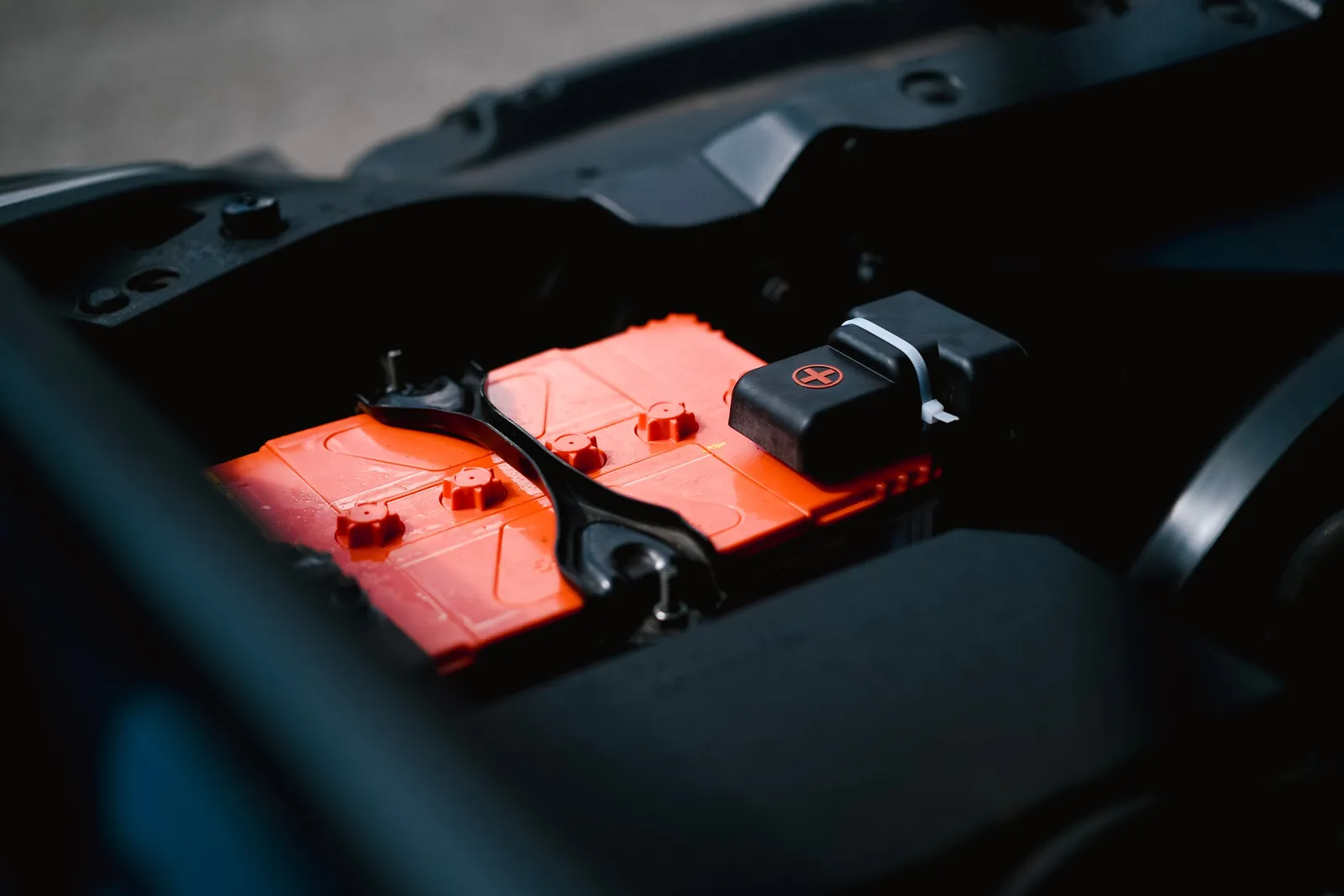
If your lead acid bank is hot, the charge voltage your controller is holding is too high for it. Victron’s gel and AGM datasheet, read August 20, 2026, gives the correction as -4 mV per cell, which works out to -24 mV per degree C for a 12V battery, measured off a center point of 25C, or 70F.
That is the whole calculation, and it is small enough to do in your head.
The math
Take a battery compartment at 40C, which is 104F and an ordinary August afternoon in the desert Southwest. That is 15 degrees above the 25C center point.
15 x 24 mV = 360 mV.
So a charger set to hold an absorption voltage tuned for a 70F battery is running about 0.36V high on that battery. At 50C, which a sealed compartment in direct sun reaches without much trouble, it is 0.6V high.
For scale, the same datasheet puts the gassing voltage of a 12V battery at 14.34V. Absorption setpoints in that neighborhood are normal. A third of a volt is not a rounding error against a threshold like that.
When the datasheet says it matters
Two triggers, both stated plainly. The datasheet says temperature compensation is required when the battery temperature “is expected to be less than 10C / 50F or more than 30C / 85F during long periods of time.” A battery box behind a skin that has been in the sun since ten in the morning clears 30C and stays there.
The second trigger is one people miss: compensation is required if charge current exceeds 0.2 C, which is 20A into a 100Ah battery. The datasheet’s reason is that the battery heats itself. It states the battery temperature “will increase by more than 10C if the charge current exceeds 0,2 C.” Add a big array and a fast controller and you have made your own heat problem.
Heat costs you when nothing is charging, too. The datasheet puts self discharge at under 2% a month at 20C and says it doubles for every 10C increase. Apply that rule and a bank stored at 40C is losing roughly four times as much.
The unhelpful part
None of this is a setting you can fix from a menu. Compensation needs the battery’s actual temperature, which means a temperature sensor on the battery. If your controller has no sensor input and no sensor attached, it cannot compensate, and guessing at a lower fixed setpoint just means you undercharge the bank in the winter.
We have not bench tested which controllers do this well, so we are not going to name one. Check whether yours has a battery temperature sensor terminal, and check whether the sensor is actually attached to the battery rather than dangling behind the panel. That second one is more common than it should be.
These are Victron’s numbers for Victron’s gel and AGM batteries. Other manufacturers publish their own compensation figures, and they do not all match. Use the datasheet for the battery you own. And none of this transfers to lithium, which has its own temperature limit at the other end of the range: we covered the 41F charging cutoff separately.
If you are sizing the array that is doing the charging, our solar calculator works the daily load side of it. For how much of a lead acid bank you can actually use before any of this matters, see the 20 hour rate and usable capacity, and our charge controllers guide for the hardware.