


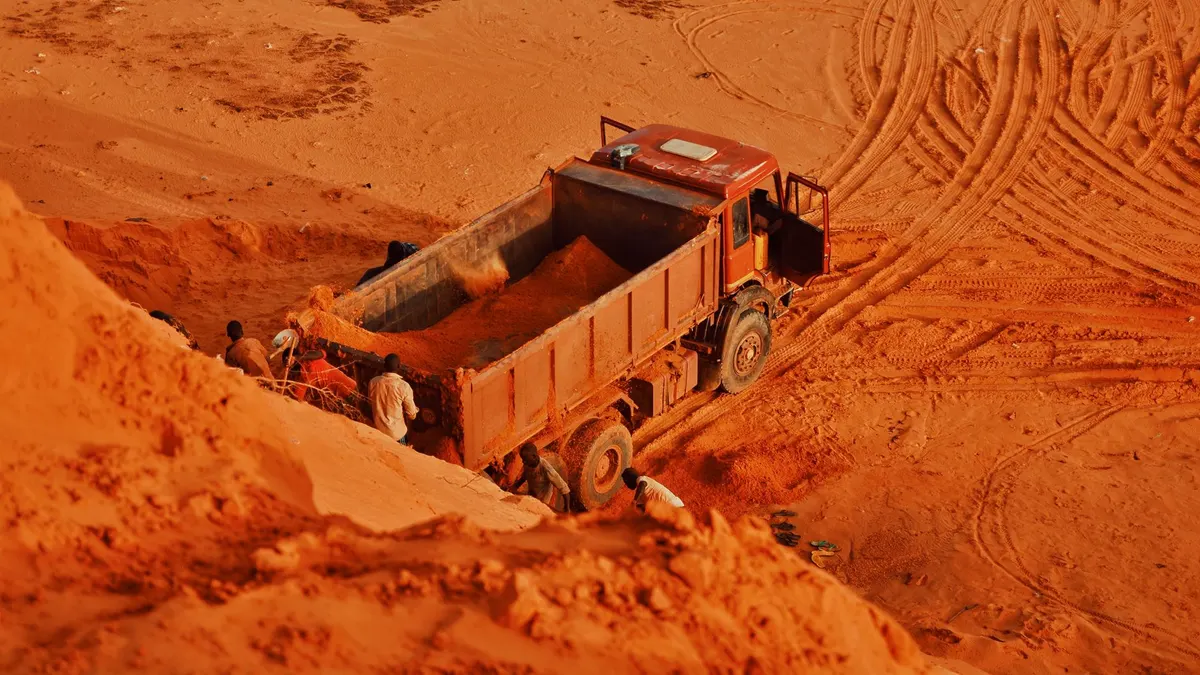
Stop spinning the tires. That is the first move and it is the one that most often gets skipped, because the instinct when a wheel slips is to add throttle. Mojave National Preserve puts it plainly: do not gun the engine, because this will spin the tires, dig you in deeper, and could bury your vehicle to the frame. Almost every frame-deep rig got there in the 20 seconds after the driver felt the first slip.
What follows is what the land agencies publish, plus the part that most recovery advice online leaves out: sometimes none of it works, and you should plan for that before you need to.
Step 1: get out and look
Turn the engine off and walk around the vehicle. You are answering three questions.
Which wheels are actually stuck, and are any of them off the ground? A wheel hanging in air on an open differential means the other wheel gets no torque, which is why a vehicle can be immobile with three good tires on solid ground.
What is under you: sand, mud, snow, or a high center where the frame or differential is resting on the ground? High-centering is a different problem than traction loss, and throttle will never fix it.
Is the vehicle in a place where it is safe to work, and is it blocking the road? Blocking, restricting, or otherwise interfering with the use of a road, trail, or gate is prohibited under 36 CFR 261.12, and on a single-lane forest road a stuck rig is exactly that. If someone can still squeeze past, do not make it worse by scattering gear across the travel way.
Step 2: dig, and clear a path
Digging is unglamorous and it is the highest-percentage move you have. Clear the sand or mud packed against the front and back of each stuck tire so the tire has somewhere to roll instead of a wall to climb. Clear whatever is bearing on the frame or the differential if you are high-centered. Then clear a ramp in the direction you intend to move, which is usually backward, along the track you already packed on the way in.
A shovel is on the Park Service’s off-road kit list for a reason, and a real one with a full-length handle beats a folding shovel by a wide margin.
Step 3: get something solid under the tires
Mojave National Preserve’s advice for a stuck vehicle: place solid materials, such as floor mats, under the tires to provide traction. That is the whole principle. Purpose-built traction boards do the same job better and are worth carrying if you regularly drive sand or mud, but the Park Service’s own equipment list for beach driving simply says extra boards for traction, and boards work.
Seat the material firmly against the tire so it does not shoot out backward when the wheel bites. Stand clear of the line it would travel if it does.
Step 4: lower the tire pressure, carefully
Reducing pressure lengthens the tire’s contact patch and floats it on soft ground instead of cutting into it. It works, and it is standard practice on sand.
The published number we can point to: Cape Lookout National Seashore recommends lowering the pressure in all tires to 20 to 25 pounds before driving onto the sand. That is a seashore recommendation for beach driving, not a universal setting for every vehicle, tire, and load, and we are not going to publish a general figure we cannot source. Airing down too far risks unseating the bead off the rim, which converts a stuck vehicle into a stuck vehicle with a flat.
Whatever you choose, carry a gauge and a pump. The Park Service’s kit list includes both, and Cape Lookout notes an air compressor for reinflating is available at each cabin office, because reinflating before pavement is not optional. Underinflated tires at road speed build heat and fail.
Step 5: smooth power, low gear, and stop when it stops working
Mojave National Preserve again: smooth, easy power is better than too much power, and you should use low gearing and just enough throttle to maintain forward movement. Engage four-wheel drive before entering deep sand or mud, not after you have stopped in it.
Try the direction you came from first. The track behind you is already compacted and you know it held your weight once.
Give it one attempt, then get out and look again. If the vehicle moved an inch and stopped, dig the new spot and repeat. If the tires spun without moving the vehicle, stop. You just made the hole deeper, and repeating it is how a 20-minute problem becomes an overnight one.
The gear that actually gets you out
The Park Service’s published off-road kit for beach driving is a reasonable baseline: tire pressure gauge, first aid kit, shovel, spare tire, air pump, tow rope with a minimum of 14 feet and 20,000 pound load capacity, litter bag, flashlight, bumper jack with a base support board, extra boards for traction, water, and a fire extinguisher.
The base support board is the item people leave home and then need. A jack sinks into sand or mud without something under it, and a jack that sinks is useless.
For remote desert routes, Mojave National Preserve adds a high-clearance 4x4 with tires designed for off-pavement use as the single most important safety item, an all-terrain spare, a second spare tire because double flats happen, extra food, water, and medications to last several days, and a satellite phone or satellite messenger.
The unhelpful part
Most recovery advice online is written by people who got out. Here is the rest of it.
Self-rescue frequently fails. A vehicle that is high-centered on a rock, buried past the axles in wet clay, or off the edge of a shelf road is not coming out with a shovel and floor mats, and hours of trying will exhaust you and your water before it moves the truck. Recognize that early.
Recovery gear hurts people. A tow rope or strap under load stores real energy, and hardware that lets go becomes a projectile. If you are not confident about the recovery points on both vehicles, do not do it.
You may be there overnight. Plan the trip so that is survivable: the food, water, medications, and clothing that Mojave National Preserve recommends for several days, not several hours.
And if you cannot get out, stay with the vehicle. The Park Service states it directly: staying with your car is the most important thing you can do in the event of an emergency, and people have died from exposure trying to walk back to paved roads. The vehicle is shelter, it is far easier to spot from the air than a person is, and it holds your water. Expect the bill if someone else does the pulling. Mojave notes third-party tow bills often reach hundreds or thousands of dollars.
One exception worth naming, because it runs the other way: if you are stuck in a wash or a low crossing and water is rising, leave. The National Weather Service reports 6 inches of moving water can knock an adult off their feet and 12 inches can float a car, and its guidance for anyone in a low-lying area is to get to higher ground immediately. A vehicle is not worth standing next to in moving water.
Not getting stuck is the actual skill
Everything above is damage control. The wins come earlier.
Check your tires before you leave pavement. The Park Service notes rental trucks and SUVs often come with street tires not designed for off-pavement use, and tells you to read the sidewall rather than trust the vehicle type. Do not trust automated routing: the same guidance says mapping and driver-assist apps often lead you astray, and coverage out there is spotty at best.
Scout the last stretch on foot when you are unsure. Turn around at the first bad section rather than the third, because the third one has a bad section behind you too. And pick ground you can leave: our choosing a site guide covers judging the surface and the turnaround before you park, and how to find your own spot covers reading the road before you ever drive it. On national forest land, remember that the road has to be designated open in the first place under 36 CFR 261.13.
Sources
- Mojave National Preserve: Sand and Mud Driving Tips
- Mojave National Preserve: 4WD Vehicles and Off-Pavement Travel Safety
- National Park Service: Desert Driving Safety
- Cape Lookout National Seashore: Tips for Beach Driving (tire pressure, off-road kit)
- 36 CFR 261.12 National Forest System roads and trails, and 261.13 Motor vehicle use, GPO
- National Weather Service: During a Flood (flood water depths)