


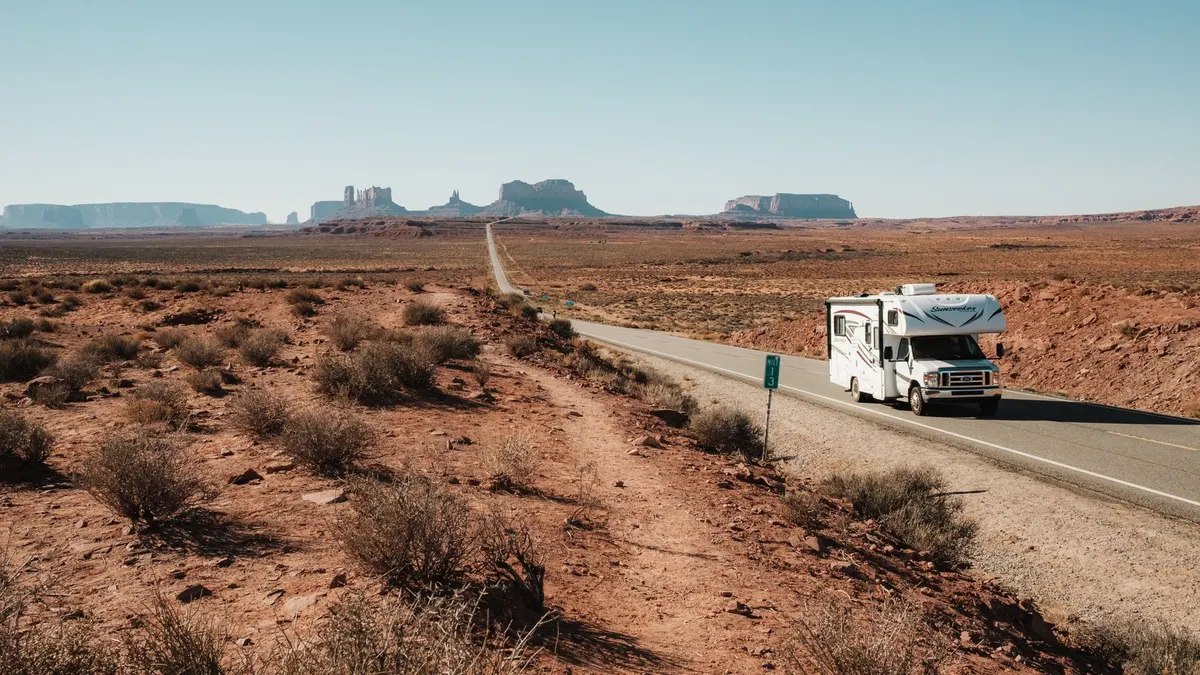
Full-time RV living means the rig is your only home, and that changes four things that have nothing to do with camping: where you are legally a resident, where your mail lands, where your health coverage works, and how you earn. Get those wrong and the trip ends early, no matter how good the van is. This page is the overview of how the whole thing fits together. The individual pieces have their own guides.
Say the unhelpful part first. Full-timing is sold as cheap and simple. It is neither by default. It becomes cheap when you own the rig outright and sleep on public land most nights, and that version costs you effort instead of money: hauling water, generating power, and moving every 2 weeks. It becomes simple after about a year, once the routines are automatic. The first year is mostly logistics.
The four things to set up before you launch
A domicile. You need one state that is legally your home. It drives your driver license, your vehicle registration and title, your voter registration, your insurance rates, and which health plans you can buy. South Dakota, Texas, and Florida are the common choices, and each has its own actual requirements published by its own agencies. We walk through what each state’s DMV, election office, and revenue department require in the domicile guide. Do not choose based on a forum post. Choose based on what the state agency says you have to do.
A mail address that works. Full-timers use a commercial mail receiving agency, which accepts mail on your behalf and forwards or scans it. USPS General Delivery covers you for short stretches. Both have rules and both have limits, covered in laundry, showers, and mail.
Health coverage that is not geographically pinned. This is the piece people discover too late. HMO and EPO plans generally do not cover out-of-network care except in an emergency, and an HMO may require you to live or work in its service area to be eligible at all (HealthCare.gov, verified July 18, 2026). A plan built around one city’s hospital system is a bad fit for someone who is 1,800 miles away in March. Details in healthcare on the road.
Income that travels. Remote work, seasonal work, retirement income, or savings. Remote work needs a real connectivity plan, because cell service on public land is thin and satellite needs sky. See internet while boondocking.
The rhythm: 14 days, then move
If you are camping free, your calendar is set by the land manager, not by you. On BLM land, dispersed camping is generally limited to 14 days within any 28-day period, with limits varying by state and field office, and when your time is up you move to a new location, often at least 25 to 30 miles away (BLM, verified July 18, 2026). National forests set their own numbers by forest order, and they differ from forest to forest. The full breakdown is in stay limits.
The posted sign and the local field office beat anything you read online, this page included.
That 14-day cadence shapes everything else. It means a two-week resupply cycle, a two-week water and waste cycle, and a moving day that costs you fuel and most of a day. Full-timers who want to stop moving pay for a monthly site instead, which is the honest trade: money for stillness.
Where the money actually goes
The costed version, built from published rate pages and fuel data, lives in monthly costs. The structural point worth making here is that pace is the lever you control.
Fuel is arithmetic: miles divided by your rig’s real mpg, times the pump price. The EIA national averages for the week of July 13, 2026 were $3.855 a gallon for regular gasoline and $4.796 for on-highway diesel. Sit still for a month and that line goes to nearly zero. Chase weather across three states and it becomes your largest bill. New full-timers almost universally move too fast, spend too much on fuel, and see nothing properly. Slowing down fixes the budget and the experience at the same time.
Everything else scales with the choice between free public land and paid sites. There is no third option that is cheap and effortless.
The water and waste cycle
This is the thing that actually governs how long you can stay put. Your fresh tank sets one clock and your grey and black tanks set another, and the shorter of the two is your real limit, not the 14-day rule. Most people run out of tank before they run out of legal days.
There is no single national directory of dump stations, so finding them is a skill rather than an app. We cover the reliable categories and the one rule you never break, which is that the potable tap and the sewer rinse hose are not interchangeable, in dump stations and fresh water. For how long a rig realistically lasts off hookups, see how long you can boondock.
What breaks
A house that takes highway vibration every travel day. Expect, over a few years: tires that age out and get replaced in sets whether or not the tread is gone, roof sealant that has to be inspected and redone, a water pump, a fridge that stops working on propane, slide seals and slide motors, and on a motorhome, engine and chassis work at truck-shop rates.
We are not going to print an annual maintenance figure, because no honest source publishes one that would apply to your rig. What we will say is that the years nothing breaks are the years you fund the years something does. Full-timers without a repair reserve are one failure away from a motel and a rental car.
Add the part nobody advertises: a shop appointment can take weeks, and while you wait, your house is in the shop.
Why people stop
Three reasons, in roughly this order.
Friction. Every routine thing becomes an errand. Water is a trip, laundry is a trip, mail is a trip, a doctor is a trip and probably a schedule change. It is manageable, and it never becomes free.
Isolation. Boondocking is quiet by design, and quiet is the point until it is not. People who thrive at it usually build some structure back in, whether that is seasonal work, a recurring circuit of the same places, or paid sites where there are other people.
A single bad event. A blown transmission, a health problem, an aging parent. A house you can drive is also a house that can be immobilized.
None of that is a reason not to go. It is a reason to launch with a repair reserve, a domicile that is actually set up, coverage that works away from home, and a slower plan than you think you want. If you are still deciding between styles of this, what boondocking is and the state-by-state free camping pages are the practical next reads.