


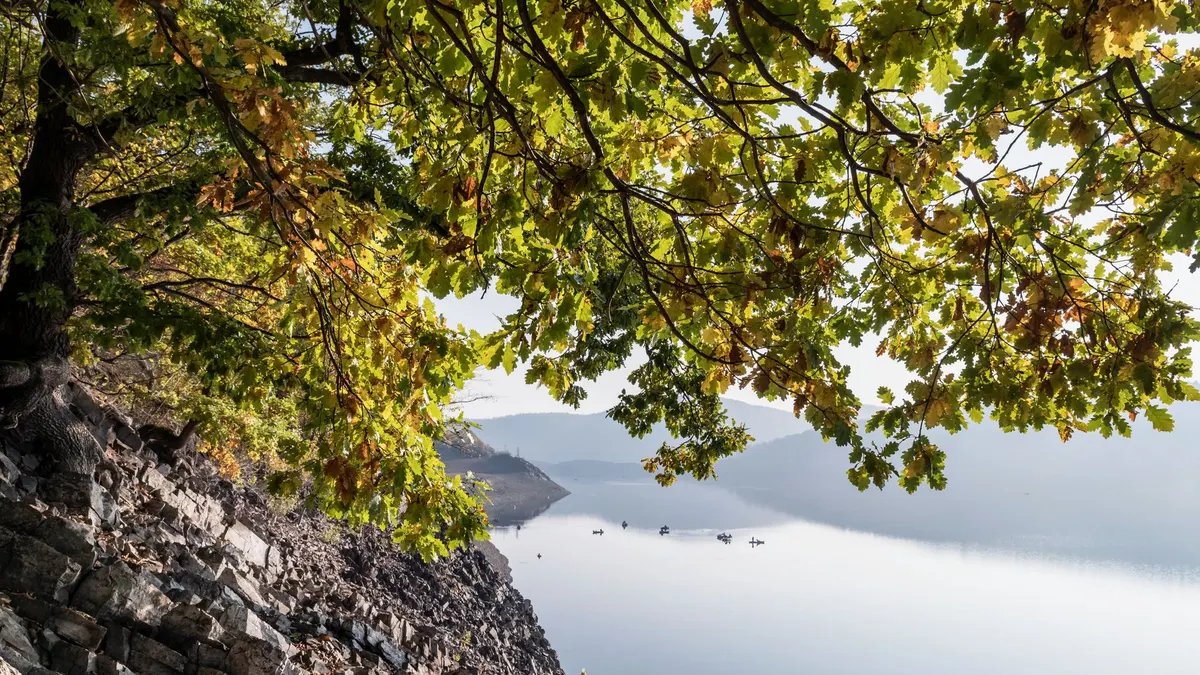
On Army Corps of Engineers land you can camp only where the District Commander has designated a site or area, and no longer than 14 days in any 30 consecutive days at any one project. Both rules are federal regulation, not local preference. 36 CFR 327.7(a) states plainly that “Camping is permitted only at sites and/or areas designated by the District Commander.” That one sentence is the difference between Corps land and the BLM land people usually have in mind when they think about free camping, and it catches a lot of travelers out.
What Corps land actually is
The Corps of Engineers builds and operates water resources development projects: dams, reservoirs, navigation locks, flood control works. The recreation land is the ground around those projects. The Corps Lakes Gateway, the agency’s own recreation portal, describes over 400 lakes in 43 states, which makes the Corps one of the largest providers of outdoor recreation in the country and by far the most common federal land in states with no BLM presence at all.
The rules come from 36 CFR Part 327, which “shall be applicable to water resources development projects, completed or under construction, administered by the Chief of Engineers.” If the sign at the gate says US Army Corps of Engineers, Part 327 is the document governing your stay.
Designated only, and why that matters
This is the rule to internalize. Federal land is not interchangeable, and Corps land inverts the assumption most campers carry.
On BLM land, dispersed camping is generally allowed unless an area is posted closed. On Corps project land under 327.7(a), camping is prohibited unless the site or area has been designated for it. Absence of a “no camping” sign is not permission. A gravel turnout by the water with a fire ring in it is not evidence of designation.
If you want the land where dispersed camping is the default, that is a different agency, and our dispersed camping guide covers where that default applies.
The 14-day limit counts by project, not by campsite
Read 327.7(b) closely: camping “at one or more campsites at any one water resource project for a period longer than 14 days during any 30-consecutive-day period is prohibited without the written permission of the District Commander.”
Two details in that sentence do the work. “One or more campsites” and “any one water resource project” mean the count follows the lake, not the site. Fourteen days spread across three campgrounds on the same reservoir is still 14 days. Switching loops does not restart anything.
And it is a rolling 30 consecutive days, not a calendar month. Ten days in early May followed by a week away leaves you 4 days when you come back, not 14, because the earlier days are still inside the window. The same arithmetic applies on BLM land, and we work through it in the stay limits guide.
The written permission clause is real. District Commanders can extend a stay, and hosts and long-term volunteers usually operate under exactly that authorization. It is not something you assume, it is something you ask for in advance.
The site rules people trip over
Part 327 is more prescriptive than the federal land regulations most campers are used to. The provisions that come up most:
- No holding a site with gear. 327.7(c) prohibits placing camping equipment or other items on a campsite, or showing up without daily occupancy, for the purpose of reserving that site for future occupancy.
- No digging, leveling, or building. 327.7(d) prohibits the digging or leveling of any ground, or the construction of any structure, without written permission. 327.20 goes further: unauthorized structures are prohibited, may be summarily removed, and the removal happens at the owner’s expense.
- Quiet hours are in the regulation. 327.12 requires quiet in all public use areas between 10 p.m. and 6 a.m., or other hours designated by the District Commander. This is not campground etiquette, it is a federal rule.
- Firewood is limited. 327.14(c) permits gathering dead wood on the ground for use in designated recreation areas as firewood, unless prohibited and posted. Cutting or gathering trees or parts of trees, or removing wood from project lands, needs written permission under 327.14(b).
- Vehicles stay on the road. Under 327.2, vehicles may not be parked in violation of posted restrictions or in a way that obstructs or impedes traffic, and off-roadway operation is prohibited except at locations designated by the District Commander.
The penalty behind all of it is in 327.25: a violation of the Part 327 regulations may be punished by a fine of not more than $5,000 or imprisonment for not more than six months or both. That is worth noticing. The equivalent Forest Service cap under 36 CFR 261.1b is $500. Most contacts end with a ranger asking you to move, but the ceilings are not comparable, and Corps projects around dams and locks are security-sensitive in a way a national forest road is not.
The lake may not be run by the Corps
One more wrinkle that explains a lot of confusing signage. 327.1(e) states that in addition to Part 327, “all applicable Federal, state and local laws and regulations remain in full force and effect on project lands or waters which are outgranted by the District Commander by lease, license or other written agreement.”
A large share of recreation areas at Corps lakes are operated by someone else under exactly that kind of agreement: a state park agency, a county, a local sponsor, a concessionaire. When that happens you can be on Corps project land while following a state park’s fee schedule, quiet hours, and check-out time, with Part 327 sitting underneath. If the campground you booked has a state park name on the entrance sign but a Corps dam a mile away, this is why.
What we could not verify
Two things people ask about constantly, which we are leaving blank rather than guessing at.
Fees. There is no single national Corps camping rate. Fees are set at the project level, and we did not find an official Corps page publishing a national schedule we could cite. Get the price from the project office or the official reservation listing for that specific campground.
The federal pass discount. The America the Beautiful Senior and Access passes are widely described as giving 50% off Corps campsites. We could not retrieve an official Corps page confirming that in July 2026, so we are treating it as unverified. Ask the project office before you budget around it.
Free primitive areas. Because 327.7(a) is designated-only, whether any free designated camping exists at a given lake is a decision the District Commander made for that project. Some projects have low-cost or primitive designated areas. We have not verified which, and a list assembled from memory would be worse than no list.
Call the project office, and then believe the sign at the entrance and the ranger over anything you read here. Corps lakes also close areas seasonally for water levels and maintenance, and the sign is the only thing that reflects that in real time. If Corps campgrounds turn out to be the practical option in your state, our campground alternatives pages cover how they compare with the rest.