


A site is worth taking if it clears five checks, in this order: it is legal, the surface is durable, it is high and dry, you can get back out, and you are not parked on top of someone. Run them in that order and you will walk away from bad spots before you have unhitched.
The check that overrides all five: read the posted sign. Districts close areas, cap stays, and ban dispersed camping in specific corridors by order, and those orders are posted at the site or at the road junction. If the sign contradicts this page or any app, the sign wins, and so does whatever the ranger district tells you today.
Legal first, because the rest does not matter otherwise
Two questions, not one. Is camping allowed here, and was the road you drove in on open to motor vehicles?
On BLM land, dispersed camping is generally limited to 14 days within any 28-day period, after which you move, often at least 25 to 30 miles (BLM camping page, verified July 2026). The same guidance asks you to camp within 150 feet of designated routes and avoid creating new tracks, and to stay at least 200 feet from lakes, rivers, and streams to protect water quality.
On national forest land, the road is the harder rule. Under 36 CFR 261.13, once a forest has designated its roads, trails, and areas on a motor vehicle use map, operating a motor vehicle other than in accordance with those designations is prohibited. Visible and legal are not the same thing.
Then confirm the ground under you is actually public. Federal boundaries carry unfenced private inholdings, and an ownership layer is the only way to be sure. Our public land types guide covers who manages what and what each allows.
Durable surface, which usually means somebody camped here already
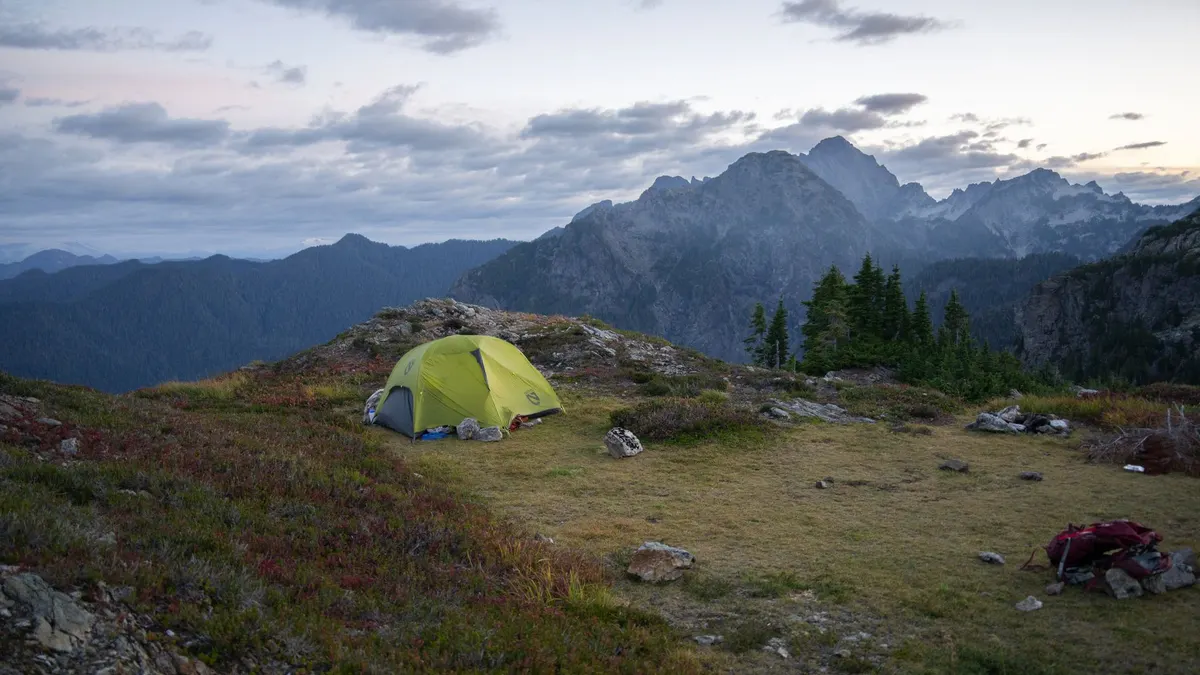
The best site is one that has already been used. Leave No Trace defines durable surfaces as maintained trails and designated campsites, rock, gravel, sand, dry grasses, or snow. A bare pullout with an old fire ring is not a compromise, it is the target: reusing an established site concentrates impact rather than spreading a new scar across untouched ground.
What to walk away from: meadows, anything green, anything low, and soft ground near water. Those spots look like the best camping in the area and they are the worst choice available. They damage on a single night, they hold water that will bog a rig, and camping in them is a reliable way to get a road gated the following season.
Do not build a new site. If there is no established spot, keep driving.
High and dry, and the numbers behind why
Flat and clear is often flat and clear because water runs through it. Judge drainage before you judge the view.
The National Weather Service puts the depths at 6 inches of moving water to knock an adult off their feet, 12 inches to float a car or small SUV, and 18 inches to carry away large vehicles, and its flood guidance tells anyone camping in a low-lying area to get to higher ground immediately when water starts rising. Those are small numbers. A channel that has been dry for months can carry them from a storm you never see, miles upstream.
Practical version: park on the shoulder above a wash, not the floor of it. Look for debris lines, scoured banks, and vegetation that stops abruptly, all of which mark where water has been. In a rig, also check that you can level without perching a wheel on the edge of a cut bank.
The way out, before the way in
Walk the exit before you park in the spot. Three questions:
Can you turn around, or will you be reversing a long way? A road a 30-foot trailer fits going in may end without room to swing it.
Will the surface hold under load, and will it hold if it rains? Dry dirt and wet dirt are different roads. Sand that packs fine in the morning goes soft in the afternoon heat.
If you get stuck here, are you blocking anyone? Blocking, restricting, or otherwise interfering with the use of a road, trail, or gate is prohibited under 36 CFR 261.12, and a rig buried across a single-lane forest road is exactly that. Park clear of the travel way.
If the surface worries you, Mojave National Preserve’s driving guidance is worth carrying in your head before you commit, not after: use low gearing and just enough throttle to maintain forward movement, and do not gun the engine, because spinning tires dig you in deeper and can bury a vehicle to the frame. More on that in getting unstuck.
Neighbors, noise, and how close is too close
There is no national spacing rule for dispersed sites, and any number you see quoted as one is somebody’s opinion. We are not going to add ours.
What is written down is the noise rule. 36 CFR 261.10 prohibits operating or using, in or near a campsite or developed recreation site, any device that produces noise, including a radio, television, musical instrument, motor, or engine, in such a manner and at such a time as to unreasonably disturb any person. In practice that means a generator, and it means the generator matters more than the distance.
The workable habit: if a pullout is taken, take the next one. If you are within earshot of another camp, run the generator during the day and not at 6am or after dark.
Waste, before you settle in
Decide where waste goes while you still have the option to move. On BLM land, dispersed campers are asked to use a portable toilet or pack out waste, and where burial is allowed locally, to bury it 6 to 8 inches deep. Leave No Trace uses the same 6 to 8 inch cathole, at least 200 feet from water, camp, and trails, and asks you to carry dishwater 200 feet from streams or lakes before washing.
Tanks are a different rule from catholes. Draining sewage or dumping waste from a trailer or vehicle anywhere except a place provided for that purpose is prohibited on BLM land under 43 CFR 8365.1-1, and 36 CFR 261.11 requires disposing of all garbage, including sewage and waste water, by removal or at a place provided for it. The full picture is in waste and dumping.
BLM also asks you to take all trash and belongings with you and not to leave personal property in place for more than 10 days, a limit written into 43 CFR 8365.1-2.
Then check the stay limit
You have picked the site. The last thing to know is how long you can keep it. Limits vary by field office and by forest, and the range is wide enough that carrying one number between agencies will get you wrong. Our stay limits guide has the figures we have verified, and our state pages carry the rest, marked “not verified” wherever we have not confirmed one.
Sources
- BLM: Camping on Public Lands (setbacks, stay limits, trash and waste)
- National Park Service: Leave No Trace Seven Principles
- 36 CFR 261.10 to 261.13 (occupancy, sanitation, roads, motor vehicle use), GPO
- 43 CFR 8365.1-1 Sanitation and 8365.1-2 Occupancy and use (BLM rules of conduct), GPO
- National Weather Service: During a Flood (flood water depths)
- Mojave National Preserve: Sand and Mud Driving Tips