

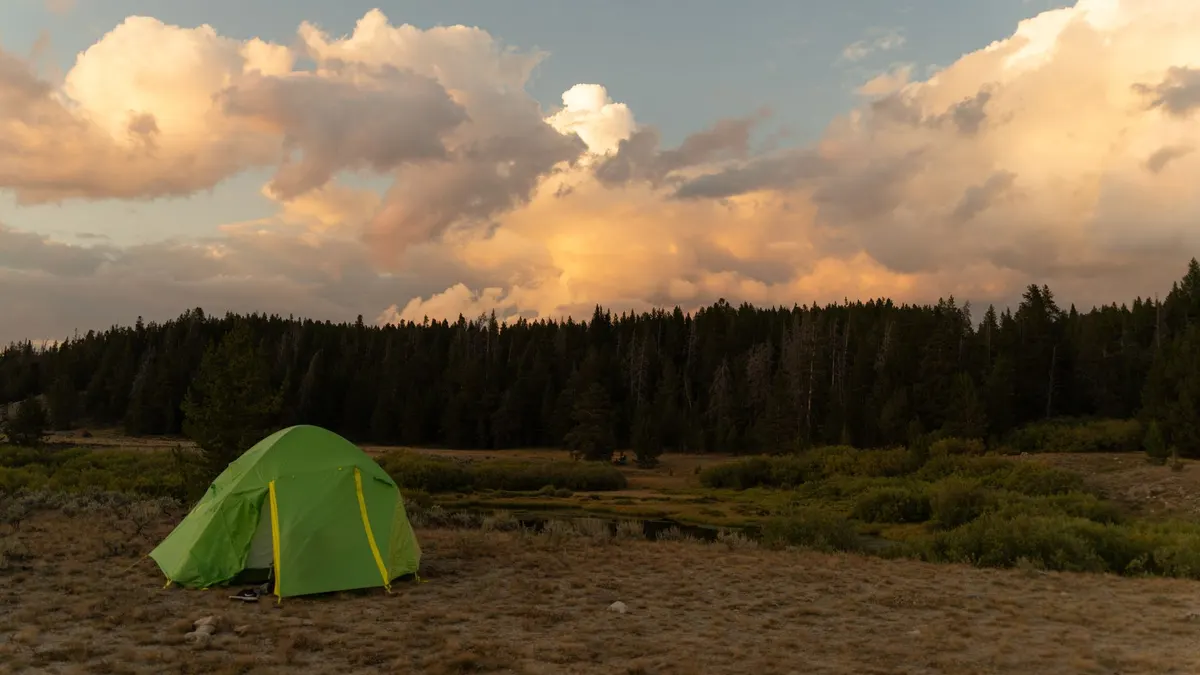
Dispersed camping is camping on public land away from developed recreation facilities. That is the actual definition, and it comes straight from BLM’s camping page, verified July 2026: “Camping on public lands away from developed recreation facilities is called dispersed camping.” No water spigot, no toilet, no trash pickup, no reserved site, and in most places no fee. Everything else you have heard about it is a local rule stacked on top of that, and the sign posted at the site beats this page every time.
What the word covers, and what it does not
Dispersed camping is a land management term, not a style of camping. It describes where you are, not what you sleep in. A tent, a rooftop tent, a van, a 30-foot travel trailer: if you are on public land outside a developed campground, you are dispersed camping.
It is worth knowing what counts as camping in the first place, because the clock starts earlier than people expect. BLM Colorado’s camping and occupancy fact sheet, verified July 2026, defines it as erecting a tent or shelter, preparing a sleeping bag or other bedding for use, parking a motor vehicle, motor home or trailer, or mooring a vessel for the apparent purpose of overnight occupancy. Pulling over and sleeping in the driver’s seat is camping. You do not get a pass for never opening the door.
The term mostly applies to BLM and Forest Service land. Other federal land runs on different rules entirely. On Army Corps of Engineers projects, for example, 36 CFR 327.7(a) states that camping is permitted only at sites and areas designated by the District Commander, which is close to the opposite of the dispersed camping default. Getting the agency right before you get the rule right is most of the work. Our guide to public land types covers who manages what.
Where it is allowed by default
On BLM land the default leans open. BLM states that most of its land allows dispersed camping unless an area is posted “Closed to Camping” or has specific restrictions for land use or conservation. That is a real default, not a loophole, and it is why the western states have so much free camping and the eastern states have so little: BLM manages very little land east of the Rockies.
National forest land works on the same general idea, but the legal mechanics are inverted. Instead of a broad grant of permission, forest supervisors close things by order. Under 36 CFR 261.58, a forest supervisor may issue an order prohibiting “Camping for a period longer than allowed by the order” and, separately, prohibiting “Camping” outright in a described area. So on the ground, dispersed camping is generally allowed in a national forest until a forest order says it is not, and that order is the document you need to find.
Neither agency owes you a campsite. Both can close an area for fire, for wildlife, for road damage, or for a restoration project, and they do it on short notice.
The stay limit is local, always
There is no national dispersed camping stay limit. BLM’s national page gives 14 days within any 28-day period as the general figure and immediately says the specific limit varies by state and field office. BLM Colorado publishes 14 days in any 30-day period at any one location, then a required move of at least 30 air miles from the spot you occupied. Air miles are straight-line miles, so on mountain roads that move is far longer than 30 miles of driving.
BLM’s national page also notes that after you hit the limit you must move to a new location, often at least 25 to 30 miles away. “Often” is doing real work in that sentence. It is guidance, not your number. Your number is the one your field office publishes.
National forests are looser still, in the sense that each one picks its own. The limits are set by forest order under 36 CFR 261.58, and they genuinely differ from forest to forest. We break the whole mechanism down in the stay limits guide, including verified examples that range from 14 days in 60 to 30 straight days.
BLM Colorado also states the line the limits exist to draw: you must not establish occupancy or use public lands for residential purposes, because camping is for recreational purposes only. That is the rule that actually gets enforced when someone settles in.
Getting to the site is its own rule
The most common way to break the law while dispersed camping has nothing to do with how long you stay. It is the last 200 feet of driving.
BLM is direct about it: vehicles must stay on designated roads and trails unless the area is specifically designated for off-road vehicle use. On national forest land the rule has teeth written into it. Under 36 CFR 261.13, once roads, trails and areas have been designated and identified on a motor vehicle use map, it is prohibited to possess or operate a motor vehicle on National Forest System lands in that unit or district other than in accordance with those designations.
There is one carve-out built for exactly this problem. Under 36 CFR 212.51(b), the responsible official may designate “the limited use of motor vehicles within a specified distance of certain forest roads or trails where motor vehicle use is allowed, and if appropriate within specified time periods, solely for the purposes of dispersed camping or retrieval of a downed big game animal by an individual who has legally taken that animal.” That is the legal basis for camping corridors alongside forest roads. Two things about it: the official may do this, not must, and the distance is set locally. There is no national corridor width, so do not carry a number from one forest into another. Learn to read the MVUM for the forest you are actually in.
The site rules worth knowing before you arrive
BLM’s guidance, verified July 2026, is short and specific:
- Camp in spots that are already disturbed, to protect plants and soil.
- Stay at least 200 feet from lakes, rivers, and streams to protect water quality.
- Use a portable toilet or pack out your waste. In some locations, bury waste 6 to 8 inches deep, at least 200 feet from water and trails.
- Fire restrictions vary throughout the year, so check current regulations before you go and follow posted guidance.
We have not verified a single national Forest Service setback distance from water or from developed campgrounds, and we are not going to invent one. Individual forests publish their own, and they differ. If you want a number for the forest you are heading to, get it from that forest’s order or its ranger district, not from a general article.
What it costs if you get it wrong
Enforcement usually starts with a ranger asking how long you have been there. The regulations behind that conversation are not trivial. On Forest Service land, violating any prohibition in 36 CFR Part 261 is punishable by a fine of not more than $500 or imprisonment for not more than six months or both, under 36 CFR 261.1b. Most encounters end with being asked to move. The citation is available if it does not.
The practical version: find out which agency manages the ground, find that office’s stay limit and move distance, keep the vehicle on a designated route, and read the sign at the pullout before you settle in. When the sign or the ranger contradicts what you read online, including here, they are right and we are out of date.
Sources
- Bureau of Land Management, Camping on Public Lands
- BLM Colorado, Camping and Occupancy fact sheet (Grand Junction Field Office)
- 36 CFR Part 261, Prohibitions (full text, GPO)
- 36 CFR Part 212, Travel Management (full text, GPO)
- 36 CFR Part 327, Public Use of Corps of Engineers Water Resource Projects (full text, GPO)