
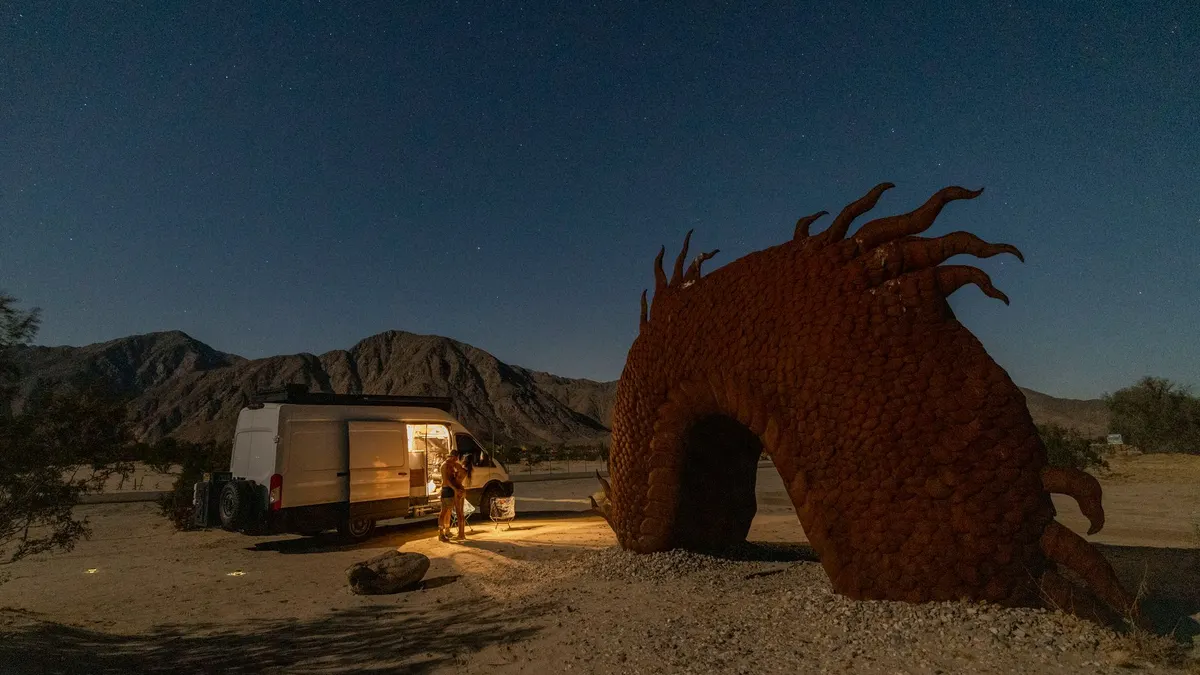
Boondocking is camping without hookups, for free, usually on public land: no water spigot, no power pedestal, no sewer connection, no fee. You bring everything in and you carry everything out. Most of it happens on Bureau of Land Management (BLM) land and in national forests, where the agencies call it dispersed camping and generally allow it at no charge for up to about 14 days.
That is the whole idea. The rest of this page is what the word covers, where it is actually legal, and what your rig needs to do it without a bad night.
Boondocking, dispersed camping, dry camping, stealth camping
These four terms get used interchangeably. They are not the same thing, and the differences matter when you are trying to figure out whether something is allowed.
Dry camping is the umbrella term: any camping without hookups. A no-hookup site in a paid state park campground is dry camping. So is a night in the desert 20 miles from pavement. The term says nothing about where you are or whether you paid.
Dispersed camping is the term the land agencies use, and it has a specific meaning: camping on public land outside a developed or designated campground. The Forest Service defines it as camping anywhere in a national forest outside a designated campground, with no services provided. When a ranger or a regulation says “dispersed camping,” this is what it means. It is the legally precise word for most of what this site covers.
Boondocking is camper slang, not an agency term. It mostly overlaps dispersed camping, but people also use it for free overnights on pavement: a Walmart lot with permission, a casino, a truck stop. Some call that “blacktop boondocking.” You will not find “boondocking” in any regulation, which is why checking rules means translating the word into what the agency actually regulates: dispersed camping on public land, or parking on private property.
Stealth camping is sleeping somewhere that camping is not clearly permitted, while trying not to be noticed, usually in a van on a city street. It sits on different legal ground than everything above. Many cities have ordinances against sleeping in vehicles, and “nobody knocked” is not the same as “it was legal.” This site covers where you can sleep openly; our car sleeping and rest area pages cover the street-legal side state by state.
Where boondocking is legal
The short answer: on most BLM land and in most national forests, unless posted otherwise, with a stay limit. Here is the longer answer, with the sources.
BLM land. The BLM states that dispersed camping is generally limited to 14 days within any 28-day period, and that specific limits vary by state and field office. After you hit the limit, you move, often at least 25 to 30 miles. The agency is explicit that dispersed camping is for short-term recreation, not long-term living, and that most areas require no permit or reservation. Vehicles stay on designated roads. (BLM camping page, checked July 2026.)
National forests. The Forest Service allows dispersed camping in most forests, usually for around 14 days, but each forest writes its own version. The Apache-Sitgreaves in Arizona, for example, allows 14 days in a 30-day period, after which you must leave the forest for at least 16 days, and asks campers to stay 100 feet from water and within 300 feet of a road. The Pacific Southwest Region says “usually 14 days” and 150 feet from water. Same idea, different numbers. The stay limit that applies to you is the one your forest publishes, so check its site or call the district office. Our stay limits guide collects how these rules work agency by agency.
Everywhere else. Parking lots are private property: legal only with permission, and overridden by local ordinance either way. See our guides to store parking and rest area rules by state. National parks are a different system entirely: camping there runs through designated campgrounds and park-specific permits, not the open dispersed model, so do not carry BLM habits into a park without reading that park’s rules first.
One rule sits above all of this: the posted sign and the land manager’s current guidance beat anything you read online, including this page. Closures happen for fire, mud, and overuse, and the sign at the road is more current than any website.
What it costs
Nothing. No nightly fee, no reservation fee, and in most areas no permit for the camping itself.
The trade-off is that you get nothing, too. No water, no power, no sewer, no trash pickup, no toilet, and frequently no cell signal. Everything a $45-a-night campground provides, you provide yourself, and everything you generate leaves with you: trash, gray water, black water, all of it. Where there is no toilet, the standard Forest Service guidance is a hole 6 inches deep at least 100 feet from water, and pack out your toilet paper. If that sentence made boondocking less appealing, that is the honest cost of free.
What you need
Self-contained is the requirement, and it comes down to three capacities plus information.
Water. Whatever your rig holds, plus jugs. Water is usually the first thing that runs out, and there is no tap to stretch it.
Power. With no pedestal, your battery bank is it, refilled by solar, your alternator, or a generator. A 12V fridge plus lights, fans, and phone charging typically runs 500 to 900 watt-hours a day, which is more than a single battery holds. Size the system before you rely on it: our RV solar calculator does the arithmetic for your loads, and our power station comparison covers the plug-and-play route.
Waste capacity. Gray and black tanks, or a cassette or composting toilet, sized to last as long as your water does. Nothing gets dumped on the ground, ever. Gray water included.
Information. Which roads are open, whether fires are allowed this week, and where the property lines are. That is a map-and-phone-call problem, covered next.
How far those capacities actually stretch is its own arithmetic. We work through it, with the tank and battery math shown, in how long can you boondock.
How to find spots
The reliable method is boring: agency maps first, then a phone call. The BLM publishes interactive maps of its land, and every national forest publishes free Motor Vehicle Use Maps showing exactly which roads are open. A 5-minute call to the ranger district answers what no app can: current closures, fire restrictions, and whether the road washboard will rattle your fillings. Apps help you shortlist, but they are leads, not law.
The full method, including how to read an MVUM and what to ask the district office, is in how to find free camping sites.
The rules where you are going
Stay limits, rest area rules, and vehicle sleeping laws all vary by state, and guessing wrong is how you meet a ranger at 2am. Our state-by-state free camping pages cover all 50 states, each citing the official source and showing the date we last verified it. Where we have not verified a rule, the page says “not verified” instead of guessing. Start with the state you will sleep in tonight.