


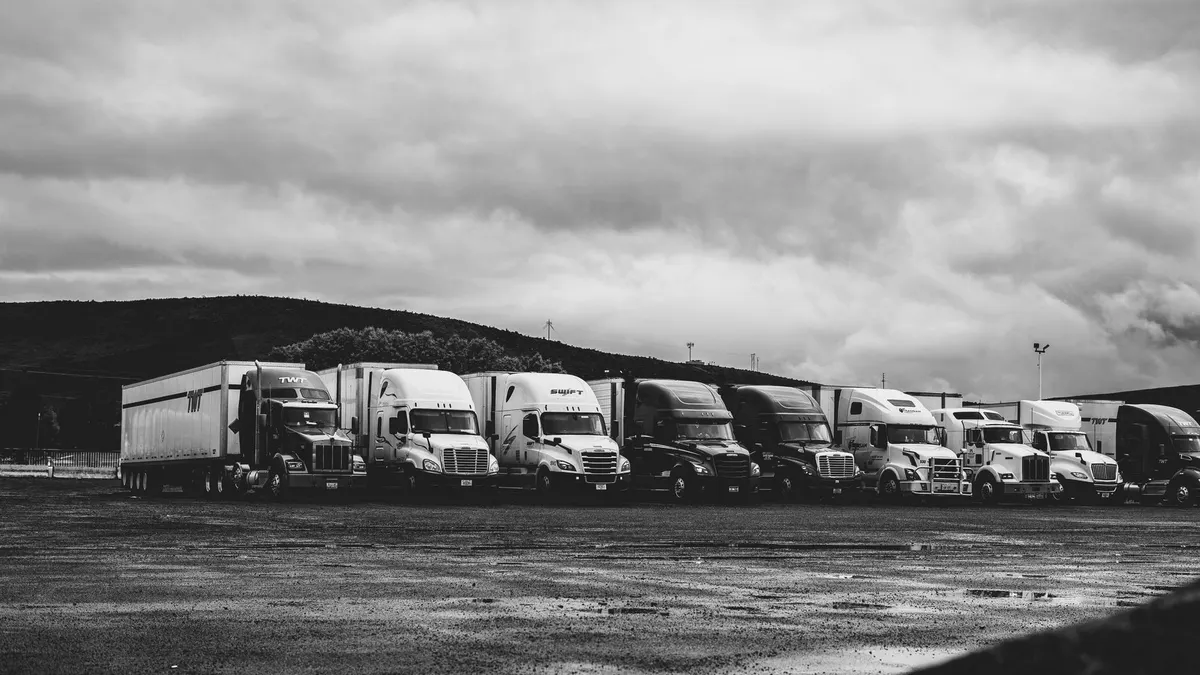
Do not park a car, van, or RV in a truck stall. That is the whole of rest area truck parking etiquette in one sentence, and everything below is why it matters more than it looks like it should. The short version: a truck driver who is out of hours is legally prohibited from driving, so a stall you took for convenience is a stall someone else needed in order to comply with federal law.
The federal rule behind the stalls
Hours of service is not a suggestion. Under 49 CFR 395.3, a property-carrying commercial driver “may not drive without first taking 10 consecutive hours off duty.” The driver then has a 14-hour window from coming on duty, may drive a total of 11 hours inside that window, and cannot drive past 8 hours of driving time without a consecutive 30-minute interruption of driving status. On top of that sit the weekly caps: 60 hours in 7 consecutive days, or 70 in 8, depending on whether the carrier runs every day.
Read the first clause again. Ten consecutive hours off duty, before driving. When a driver reaches that point in a full lot, there is no version of “just go a bit further.” Going further is the violation. Parking on a shoulder or an exit ramp is the alternative, and it is a worse one for everybody on that road.
States write the difference into their own rules
Several states put the split directly into the rest area rule, which is the clearest evidence that the two sections are not interchangeable.
Minnesota’s policy states that commercial operators subject to hours-of-service rules under 49 CFR 395 “may stop and park continuously, for a period of up to ten hours as necessary to comply with the hours of service regulations, at any MnDOT safety rest area or travel information center that has parking stalls designed to accommodate a commercial motor vehicle.” All other motorists get 4 hours where posted. Note the qualifier on the stalls. The state is describing a specific physical resource with a specific purpose.
Florida runs the same structure with different numbers: 3 hours for the general public, 10 hours for commercial motor vehicle operators subject to hours-of-service rules. South Dakota permits temporarily resting in a vehicle for up to 3 consecutive hours generally, and up to 10 for commercial drivers under 49 CFR 395.
States with a single flat cap apply it to everyone. Texas allows 24 hours to any vehicle. Oregon allows 12. Wisconsin defines long-term parking as 24 continuous hours or the posted limit, whichever is shorter, occupied or not. Our rest area time limits guide has the verified figure for every state that publishes one.
The shortage is documented, not folklore
The Federal Highway Administration describes truck parking shortages as “a national safety concern,” and notes that drivers facing difficulty finding parking may continue driving or park unsafely on road shoulders and exit ramps. Jason’s Law, Section 1401 of MAP-21, established “a national priority on addressing the shortage of long-term parking for commercial motor vehicles on the National Highway System,” and required the Department of Transportation to evaluate state capacity and develop metrics for it. FHWA’s own assessment is that with projected growth in e-commerce and truck traffic, demand will continue to outpace supply.
That is the context for a full lot at 11pm. It is not that drivers arrived early to be inconvenient. There are not enough spaces, the problem is formally recognized, and it is getting worse rather than better.
What good etiquette looks like
Use the car section even when the truck side looks better. An empty truck stall at 9pm is not evidence of surplus. It is evidence that the drivers who will need it are still 100 miles out and running down their 11 hours.
If you are in a big rig, take the least useful stall. A 40-foot motorhome frequently will not fit in a car space, and pretending otherwise does not help anyone. The honest answer is that you are competing for the same resource and there is no clean solution. Take the far end, pull through if the geometry allows so you are not blocking a backing maneuver, and be gone early rather than sleeping to the limit.
Do not block the through lanes. The interior lane a truck uses to swing into a stall needs the full width. Parking half in it, even briefly, forces a driver into a maneuver they cannot see out of.
Back in or pull through, but do it once. Trailers reverse slowly and the lot is dark. Repositioning three times at 2am is worse than the spot you first picked.
Keep the pets on the car side. Most rest areas have a marked pet area for exactly this reason. Walking between trailers is where visibility is worst.
Expect noise and do not fight it. Refrigerated trailers cycle their units all night, and that is cargo, not inconsideration. If you need quiet, park at the end of the car row furthest from the reefer stalls, or pick a different kind of stop.
Do not plug into anything. Idaho prohibits “plugging vehicles, generators, or other camping devices into any outlets at rest areas” and hooking hoses to water faucets. Beyond the specific state rule, running a generator or stringing a cord is the clearest possible signal that you are camping rather than resting, and camping is the thing most rest area rules actually prohibit.
Why the facilities are free in the first place
Under 23 CFR 752.5, no charge to the public may be made for goods and services at a safety rest area, except telephones and vending machines. That is why the lot is free and also why it is spare. Nobody is being paid to expand it based on demand, and the money to build more comes out of highway programs rather than the parking itself.
Which is a long way of saying the courtesy is the infrastructure. There is no market mechanism sorting out who gets the space, so it comes down to whether the person in the car takes a truck stall.
If the lot is full
Move on and try the next one rather than inventing a space. Parking in a fire lane, on the entrance ramp, or across the end of a row puts you in the way of vehicles that cannot stop quickly and gets you reported first when someone walks the lot. Wisconsin’s guidance is a fair model of what follows: an overstaying or improperly parked vehicle gets reported to the State Patrol and the removal procedure begins.
If you keep hitting full lots on a route, the fix is planning rather than luck. Campground alternatives covers the other overnight options, which run on a property owner’s permission instead of state law, and the state-by-state rest area pages show where the limits are long enough to be worth targeting.
And wherever a sign in the lot marks a section, a limit, or a restriction, the sign wins over anything on this page.
Sources
- 49 CFR 395.3, Maximum driving time for property-carrying vehicles (GPO)
- Federal Highway Administration, Truck Parking (Jason's Law)
- Minnesota Department of Transportation, Rest Area Policy
- Florida Department of Transportation, Rest Area Q&A
- South Dakota Codified Law 31-7-17
- Idaho Transportation Department, Rest Areas FAQ
- Wisconsin Department of Transportation, Rest Area Guidelines and Policies
- 23 CFR 752.5, Safety rest areas (GPO)