


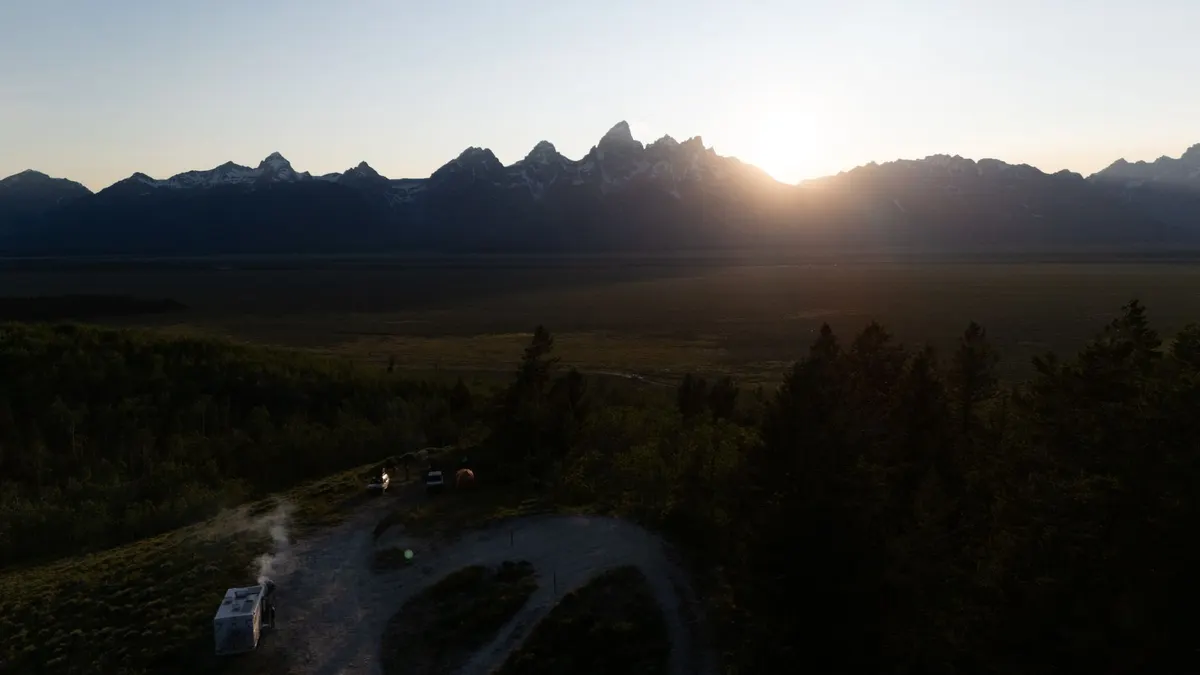
Legally, you can usually boondock 14 days in one spot on BLM or national forest land. Practically, most rigs tap out days earlier, when the fresh tank runs dry or the battery quits. So the honest answer has two halves: the rule, and the math.
The legal limit: 14 days, usually
The BLM states that dispersed camping is generally limited to 14 days within any 28-day period, with specific limits varying by state and field office. When your time is up, you move, often at least 25 to 30 miles away, and the agency is explicit that dispersed camping is for short-term recreation, not long-term living. (BLM camping page, checked July 2026.)
National forests run on the same idea with local variations, and the variations are real. The Apache-Sitgreaves National Forests in Arizona allow 14 days in a 30-day period, then require you to leave the forest for at least 16 days. Other forests count 14 days against a 30-day, 60-day, or calendar-year window. “Usually 14 days” is the pattern, not a promise, and the number that binds you is the one your forest or field office publishes. When in doubt, call the district office; the Forest Service itself tells campers to ask there about stay limits.
Two more things about the legal half. First, the clock does not reset by driving to town for groceries and coming back. Second, the posted sign and the land manager beat this page and every other website. Closures and emergency restrictions never hit the internet as fast as they hit the signboard.
How these limits work across agencies and states, including the outliers, is covered in our stay limits guide.
The practical limit: run the math for your rig
Long before day 14, three gauges decide when you leave: fresh water, battery, and waste tanks. The arithmetic below is the planning math, with the assumptions stated. Swap in your own numbers; they are on your rig’s spec sheet and battery label.
Water math
Plan on roughly 1 gallon per person per day for drinking and cooking. Add dishes, hand washing, and teeth, and a frugal camper lands around 2 to 3 gallons per person per day. Showers are the multiplier: even a navy shower adds a couple of gallons per person each time.
The math: fresh tank gallons ÷ (people × gallons per day) = days.
Worked example: a 30-gallon fresh tank and 2 people at 3 gallons each is 30 ÷ 6, or 5 days. A solo camper in a van with a 20-gallon tank at 2.5 gallons a day gets 8 days. Jerry cans extend this cheaply: two 7-gallon jugs buy that couple 2 more days.
These are planning figures for frugal use, not measurements of anyone’s actual consumption. Your habits are the biggest variable, so run a weekend on your tanks and see what your gauge says.
Power math
A 12V compressor fridge plus lights, fans, and phone charging typically draws 500 to 900 watt-hours (Wh) a day. Laptops, a diesel heater fan, or an inverter running anything with a heating element push it higher.
What you have: a 100Ah 12V lithium (LiFePO4) battery stores about 1,280Wh and lets you use nearly all of it. A 100Ah AGM or other lead-acid battery stores the same on paper but should only be drawn down about half, so roughly 640Wh usable.
The math: usable Wh ÷ daily Wh = days without recharging.
Worked example: one 100Ah lithium battery at 700Wh a day is 1,280 ÷ 700, or under 2 days. The same size AGM is under 1 day. That is why boondockers bolt on solar: the battery stops being the budget and becomes the overnight buffer, and your limit becomes whether the panels can replace what you burn each day. That depends on panel wattage, season, and shade, which is exactly what our RV solar calculator estimates for your setup. If your loads outrun any sane roof, our generator sizing tool does the same math for a generator.
Tank math
Grey water fills at nearly the rate fresh water drains, minus what you drink. So if your grey tank is smaller than your fresh tank, grey sets the clock, not fresh. Check both numbers on the spec sheet; plenty of rigs carry less grey than fresh.
Black tanks usually last longer than either, because an RV toilet uses far less water per flush than a household one, and a cassette or composting toilet takes black plumbing out of the equation entirely. Whatever you carry, it leaves with you. Nothing gets dumped on the ground, grey water included, and the fine for doing it is the least of the reasons.
The real answer
Take the smallest of the three numbers above. That is how long you can boondock, and for most rigs it is 3 to 7 days, comfortably inside the 14-day rule. Extending it is a gear problem with known solutions: more water storage, more battery, solar to refill it. Start with the solar calculator and see what your daily watt-hours actually cost to replace. And if you have not read it yet, what is boondocking covers the rules side from the top.