


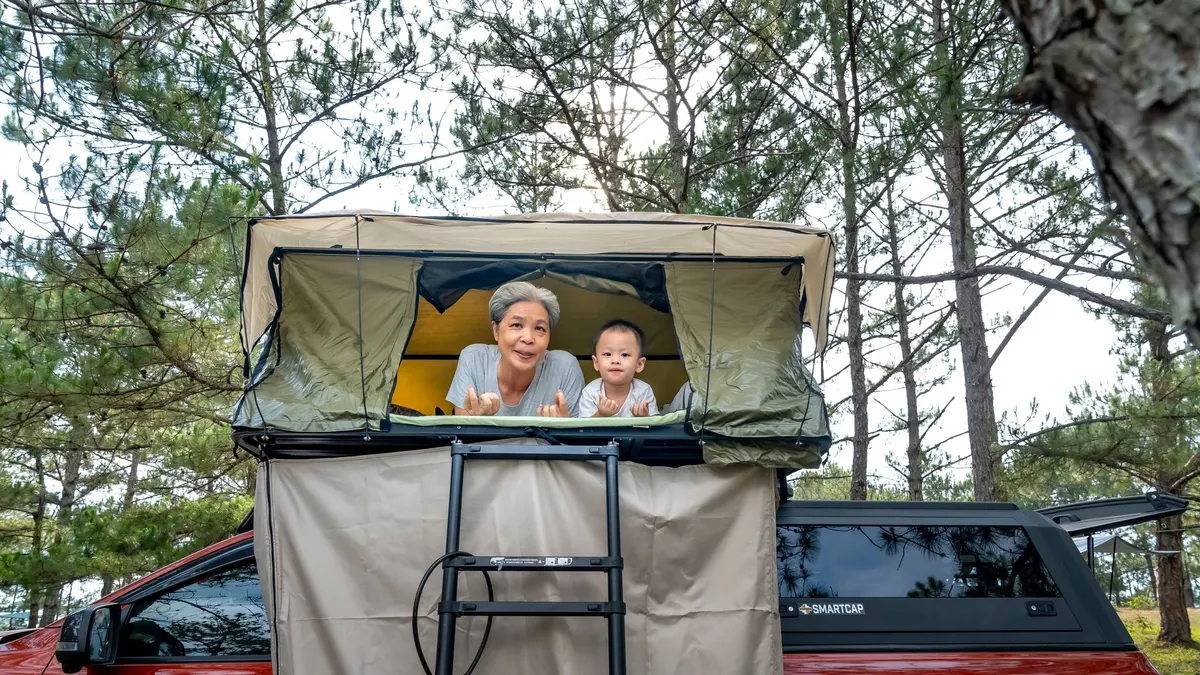
Before you shop for a rooftop tent, open your vehicle’s owner’s manual and find the roof load limit. That number, not the tent’s features, decides whether any of this is possible, and it is the check most buyers skip. Thule’s own rooftop tent guidelines start in the same place: check your vehicle instruction manual or contact your local dealer to determine the weight limitations of your roof, and understand that this figure is the dynamic weight capacity, the maximum weight permitted on the roof while driving.
We are not going to publish a table of roof load limits by vehicle. They vary by model, by year, and by whether your roof has a panoramic glass panel, and a wrong number here is how someone bends a roof. Look up yours.
Dynamic load is the constraint, static load is the reassurance
Thule’s guidelines define the two capacities plainly. Dynamic weight capacity is what the roof can carry while you drive. Static weight capacity is the tent in use, with people inside, when the vehicle is parked. Static can exceed dynamic, and as a guideline Thule states the static capacity of its roof racks is 3x the dynamic capacity.
This is why a 160 lb roof limit can still hold two adults overnight. It is also why the marketing tends to lead with static numbers. Thule lists 660 lb static capacity for both the Basin and the Approach M. iKamper lists about 900 lb for the Skycamp 3.0. Those are comforting numbers, and they are not the ones that will stop you at the shop.
Do the dynamic arithmetic instead, and count everything. Thule publishes 176 lb for the Basin hard shell, 128 lb for the Approach M soft shell. iKamper publishes 165 lb for the Skycamp 3.0 and states outright that the vehicle needs a dynamic roof load of at least 165 lb. Now add the rack. Thule’s article on fitting a tent says the tent combined with roof racks must stay within the vehicle’s limit, and the guidelines add a rule people miss: bars, feet and fit kits can have different capacities, and the component with the lowest capacity determines the whole system’s maximum. Thule’s WingBar Evo page states it safely carries loads up to 220 lb. If your rack tops out at 220 lb and your tent is 176 lb, you have 44 lb of headroom before the rack is the limit, and the vehicle’s own number might be lower still.
Two more constraints from the same Thule document, both of which quietly disqualify a lot of vehicles. If your car has a glass or large panoramic roof, Thule says to always check with the vehicle manufacturer that the roof can support a tent. And rooftop tents should only go on raised roof rails that are supported, because unsupported rails are usually too flexible to handle the static load of a tent with people inside. Thule also names specific racks of its own that are not compatible with its tents, including Evo Clamp and Edge Clamp feet, all WingBar Edge racks, and SlideBar crossbars, because the high static load can damage the rack or the vehicle. The rack you already own may not be the rack you need.
One geometry check while you are at it: Thule requires a front-to-back bar spread of at least 28 in (70 cm) to properly support a tent, and publishes a per-model minimum side-to-side spread. Measure your bars. Thule notes its own online vehicle selector does not account for bar spread.
Setup time is honest, camp time is not
The published setup claims are real and also incomplete. iKamper states 60 seconds for the Skycamp 3.0. Thule describes the Basin as auto-deploying in under a minute. Both are describing the shell popping open.
What the clock does not cover: getting the cover off, positioning and securing the ladder, running guy lines if it is windy, hauling bedding up, and in the morning doing all of it backwards while the fabric is wet with condensation. A soft shell like the Approach M has more fabric to fold and a cover to fight. A hard shell like the Basin is faster on both ends, weighs 48 lb more, and costs more.
The real cost is not the minute. It is that your bed is attached to your vehicle. You cannot leave camp for a trailhead, a town run, or a dump station without packing the tent down first, and you cannot come back to a claimed site. If your style of trip is one basecamp for four days, that barely matters. If you move daily, or you camp somewhere you want to drive out of during the day, you will feel it on every single outing.
The costs nobody puts on the spec sheet
Fuel. We could not find a published fuel economy measurement for a rooftop tent, so we are not going to invent one. The closest verified figure is from the Department of Energy’s fueleconomy.gov, which states a large, blunt roof-top cargo box can cut fuel economy by around 2% to 8% in city driving, 6% to 17% on the highway, and 10% to 25% at Interstate speeds of 65 to 75 mph. A tent is a different shape than a cargo box. Treat that as the closest honest proxy and expect a real penalty on long highway days.
Clearance. Thule lists the Basin at 12.75 in tall closed and the Approach M at 11 in. That height sits on top of your crossbars, which sit on top of your roof. Add it up and measure your garage door, your parking structure, and the drive-through you use. Then take a piece of tape and mark the total height somewhere you will see it, because the failure mode here is expensive and instant.
Weight up high. A hundred and seventy-six pounds on the roof raises your center of gravity. It changes how the vehicle feels in crosswinds and on off-camber forest roads, which matters more than the number suggests when you are picking your way into a dispersed site. Our guide to choosing a site covers reading approach and surface, and the calculus changes when your rig is top-heavy.
Do not buy one if
- Your vehicle’s dynamic roof load limit is below the tent weight plus your rack. This is not negotiable and no accessory fixes it.
- You move camp most days, or you want to drive out from camp during the day.
- You park in a height-restricted garage.
- Your only roof attachment is unsupported roof rails or a rack the tent maker explicitly excludes.
- You mostly camp alone in one vehicle and already have room to sleep inside it. An interior sleeping platform costs a fraction as much, adds no height, no drag, and no setup, and lets you drive away without packing. See building a platform.
- You want the cheapest way to sleep outdoors. A ground tent is lighter, cheaper, quieter in wind, and does not care what you drive.
A rooftop tent earns its keep for people who camp on rough or wet ground, who basecamp rather than move nightly, and who already own a vehicle with the roof rating and the rack to support it. That is a narrower group than the product photos imply, and there is no shame in being outside it.
Where you can put it matters too
A deployed rooftop tent is unmistakably camping. That distinction is legally live in a lot of places where sleeping in a parked vehicle is tolerated but setting up camp is not, so a rooftop tent narrows your options compared to sleeping inside the vehicle. Read camping vs overnight parking before you assume a spot works, and check where car camping is legal for the state-level picture.
And the part that outranks everything above: the posted sign and the land manager’s current guidance beat this page and beat any app. If the sign says no camping and you are about to pop a tent on your roof, the sign is talking to you.
Sources
- Thule Rooftop Tent Guidelines, document 5564366001 (dynamic vs static weight capacity definitions, 3x static guideline, glass and panoramic roof warning, raised rail requirement, lowest-capacity component rule, incompatible rack list, 28 in minimum front-to-back bar spread), Thule Group March 2024, accessed July 18, 2026
- Thule, How do you know if a rooftop tent fits your vehicle (every car has a manufacturer-specified maximum roof load; the tent combined with roof racks must stay within it), accessed July 18, 2026
- Thule, Basin specifications (176 lb weight, 660 lb static load capacity, 84 x 55 x 12.75 in closed, 84 x 55 x 42.75 in open, 2 person, 81 x 51 in sleeping footprint, 36 in peak internal height), accessed July 18, 2026
- Thule, Approach M specifications (128 lb weight, 660 lb static load capacity, 49 x 56 x 11 in closed, 95 x 56 x 40 in open, 3 person, 40.2 in peak internal height), accessed July 18, 2026
- Thule, WingBar Evo product page (safely carries loads up to 220 lb), accessed July 18, 2026
- iKamper, Skycamp 3.0 specifications (165 lb weight, 165 lb minimum vehicle dynamic roof load, about 900 lb static capacity, 2.5 in mattress, 13.5 in closed height, 60 second setup), accessed July 18, 2026
- US Department of Energy and EPA, fueleconomy.gov, Driving More Efficiently (roof-top cargo box fuel economy penalty of 2 to 8% city, 6 to 17% highway, 10 to 25% at 65 to 75 mph), accessed July 18, 2026