


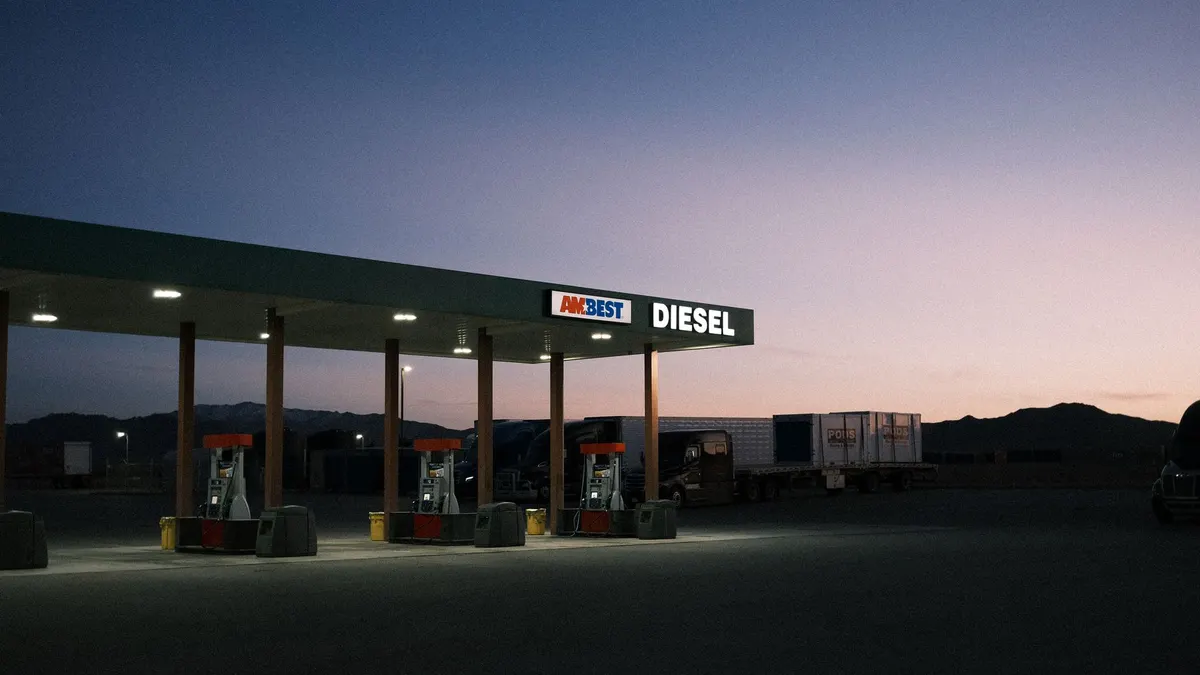
Yes, you can generally sleep at truck stops, and the two biggest chains say so on their own sites. The rule that matters more than any of that: the lot exists for truck drivers on federally required rest, and an RV in a truck spot at night can cost a working driver their legal place to park. Sleep there, gladly, but take the leftover space.
What the chains actually say
Pilot Flying J’s RV services page, verified July 17, 2026, invites RVers to “park in our overnight spaces for a safe travel break.” The same page lists RV fuel lanes, RV dump stations, and cylinder and bulk propane refills.
Love’s runs the same welcome through a bigger program. Beyond ordinary lot parking, Love’s operates reservable RV Stops and RV hookup sites at travel stops across the country. Its October 2023 announcement put the network at an expected 51 locations and 1,130 hookups by early 2024, with 30- or 50-amp service, water, Wi-Fi, and dump access at the sites.
Neither chain publishes a nationwide price list for reserved RV sites or showers. Pricing is per location through their apps and booking sites, so we are not quoting numbers here.
Why truckers come first
Federal hours-of-service rules (49 CFR 395, FMCSA) cap how long a commercial driver can drive and then require rest, including a minimum of 10 consecutive hours off duty in the standard property-carrying cycle. A driver who parks at 9 p.m. is not choosing a preference. They may be legally done, unable to drive another mile until the clock resets.
Truck parking is scarce. When an RV takes a marked truck spot at night, a driver who arrives at midnight may have nowhere legal left, and the options at that point are all bad ones. So the etiquette is not really etiquette, it is closer to a moral rule of the road:
- Never take a marked truck spot at night. Not “just this once,” not “the lot looks empty.” It fills at 1 a.m.
- Park in the car/RV area or at the edge of the lot, out of the truck traffic pattern. If it is not obvious where, ask inside. Staff will point you somewhere specific.
- Fuel in the RV lanes or auto lanes, not the diesel truck lanes, unless the location directs you there.
- Pay for a reserved spot where one is offered. Love’s RV Stops exist exactly for this. Pilot’s Prime Parking reservation program is built for trucks (its site describes semi and bobtail parking), so at Pilot the RV answer is the overnight spaces, not a reserved truck spot.
What you get for a night
A truck stop is the best-equipped parking lot in America. Open 24 hours, lit, food, fuel, restrooms all night. Paid private showers with towels. Laundry. Propane fills, including fixed-tank service at many locations. Dump stations at many Pilot and Love’s locations, with Pilot offering discounted dumping through its Good Sam partnership. If your tanks are full and your water is empty, one stop fixes everything. That combination is why a truck stop often beats a silent but serviceless lot.
The honest part: it is loud and bright all night. Reefer trailers cycle, engines idle, the fuel canopy glows like noon. This is a rest break, not camping. Earplugs and window covers make it workable.
The one-night rule, again
Same convention as any parking lot: 1 night, no setup, no jacks or awnings or chairs, leave nothing behind, gone by morning. Buy something; you are using a business’s infrastructure. And whatever any website says, the posted sign and the person behind the counter are the current policy for that lot. If either says no, that is the answer.
When a truck stop is the wrong answer
If you want quiet, a truck stop will lose to almost anything. Rest areas are quieter but rule-bound, and the rules swing hard by state, from 3-hour limits to explicit overnight permission, so check your state first. Store lots are quieter but manager-dependent. Casinos trade a security patrol for the hope you will come inside. And if you have 30 spare minutes of driving, free camping on public land beats all of it on every axis except convenience.