

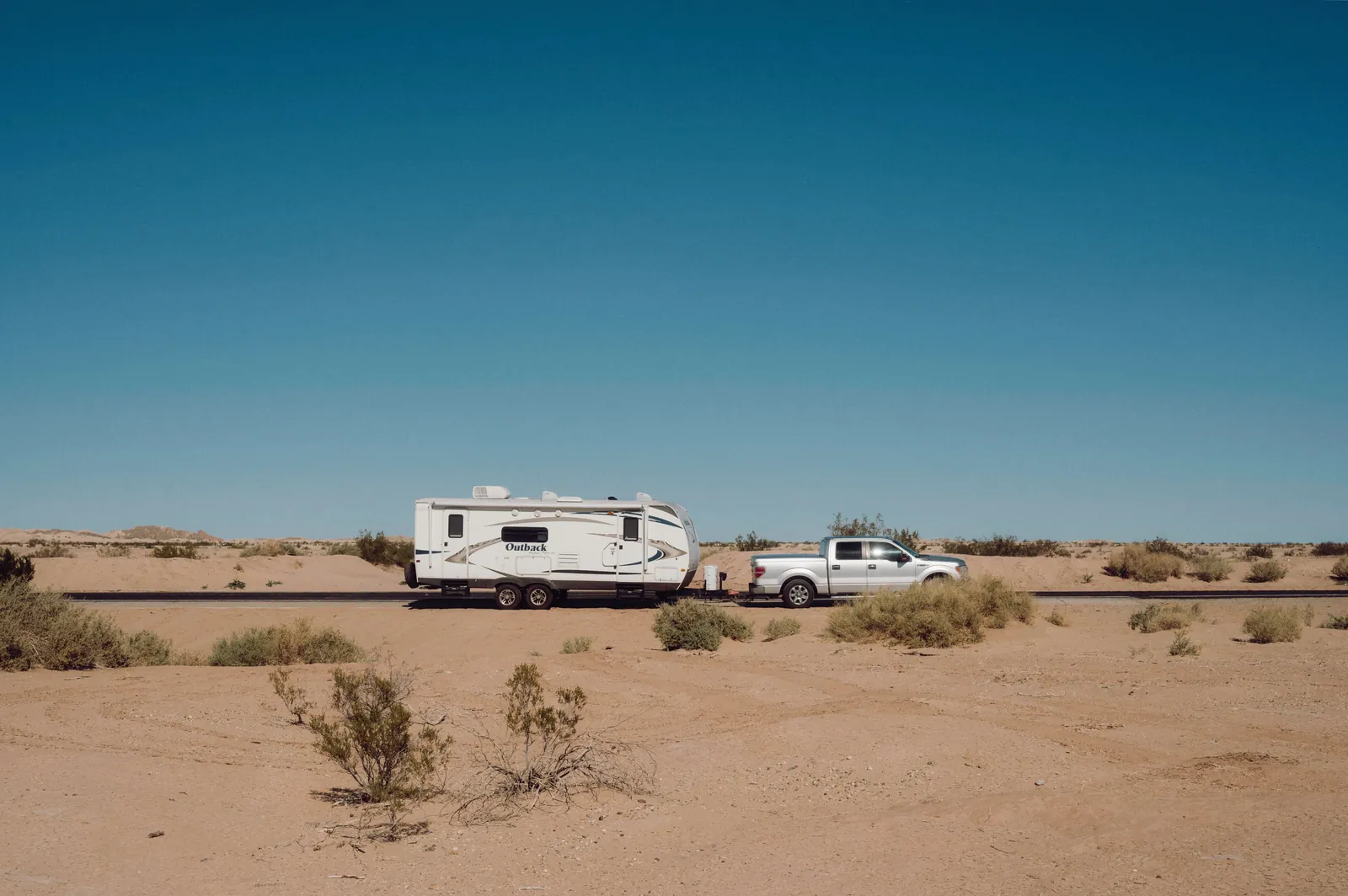
If a national park campground posts a length limit, the number it wants is your tow vehicle plus the hitch plus the trailer, added together. Not the trailer on its own. Get that wrong and you can lose the site at the kiosk.
Rocky Mountain National Park writes the arithmetic out rather than leaving it to you. Its Moraine Park listing, read September 17, 2026, says vehicles larger than 40 feet are not permitted, then spells it out: “Trailer length is the total maximum vehicle length allowable. (Trailer Length = Trailer + Hitch + Vehicle) Maximum Vehicle + Trailer Length = Vehicle + Trailer + Hitch = 40 ft at Moraine Park Campground.”
Run your own numbers on that. A 20 foot crew cab pickup, a 3 foot hitch and coupler, and a 22 foot travel trailer is 45 feet. The trailer is well under 40. The rig is not.
Death Valley says out loud what the others imply
Furnace Creek is the one that puts the consequence in writing. Its listing, read September 17, 2026, says “your total length is the vehicle plus trailer or rv plus tow vehicle. Only one RV unit is allowed per site,” then: “If you choose a site that does not fit your total length, the Park reserves the right to cancel your reservation upon arrival.”
It adds a second measurement most people never think about: “All wheels must fit on the pavement provided at the site.” A rig that fits the stated length can still fail that if the pad is short and you would be parking a wheel on dirt.
That is a live problem for anyone heading to the desert now. We covered the season dates in Death Valley winter camping.
A site-level limit is not the same as a campground limit
Grand Canyon’s Mather listing caps motorhomes and trailers at 30 feet, then narrows it further: “If your trailer is 30’ long, book sites 120, 121, 128, 172 or 185 (other sites will NOT fit a 30’ trailer).” Five sites out of the whole campground. Booking a 30 foot trailer into any other site technically clears the campground limit and still does not fit.
Mather also allows up to two standard-sized vehicles per site and says to keep them all on the pavement.
Read the verb, not just the number
Two Recreation.gov listings can carry a similar number and mean different things.
Yellowstone’s Slough Creek listing says the campground “has a very tight turnaround - vehicles longer than 25 ft (7.6 m) are not recommended.” That is advice. At 28 feet you are gambling on your own reversing, not breaking a rule.
Moraine Park says vehicles larger than 40 feet “are not permitted.” That is a limit.
And some limits are not about the site at all. Zion’s Watchman listing points at the road: from June 7, 2026, vehicles over 35 feet 9 inches long, 11 feet 4 inches tall or 7 feet 10 inches wide are not allowed through the Zion Mt Carmel Highway, so large rigs must enter and exit via the South Entrance in Springdale. Your site is reachable. Your route is not.
What to do
Measure the rig once, hitched, bumper to bumper, and write the number down. Then read the full listing for the specific campground before you book, not the search result summary: the limits that bite are in the notices, not the site attributes.
If the listing is ambiguous, call the campground. The posted information at the kiosk and what the ranger tells you on arrival beat any website, including this one. Our national park camping rules page covers what else is set per park rather than servicewide, and national park camping limits are parkwide covers the other number that catches people out.
Sources
- Moraine Park Campground, Rocky Mountain National Park, Recreation.gov facility listing
- Mather Campground, Grand Canyon National Park, Recreation.gov facility listing
- Furnace Creek Campground, Death Valley National Park, Recreation.gov facility listing
- Slough Creek Campground, Yellowstone National Park, Recreation.gov facility listing
- Watchman Campground, Zion National Park, Recreation.gov facility listing