
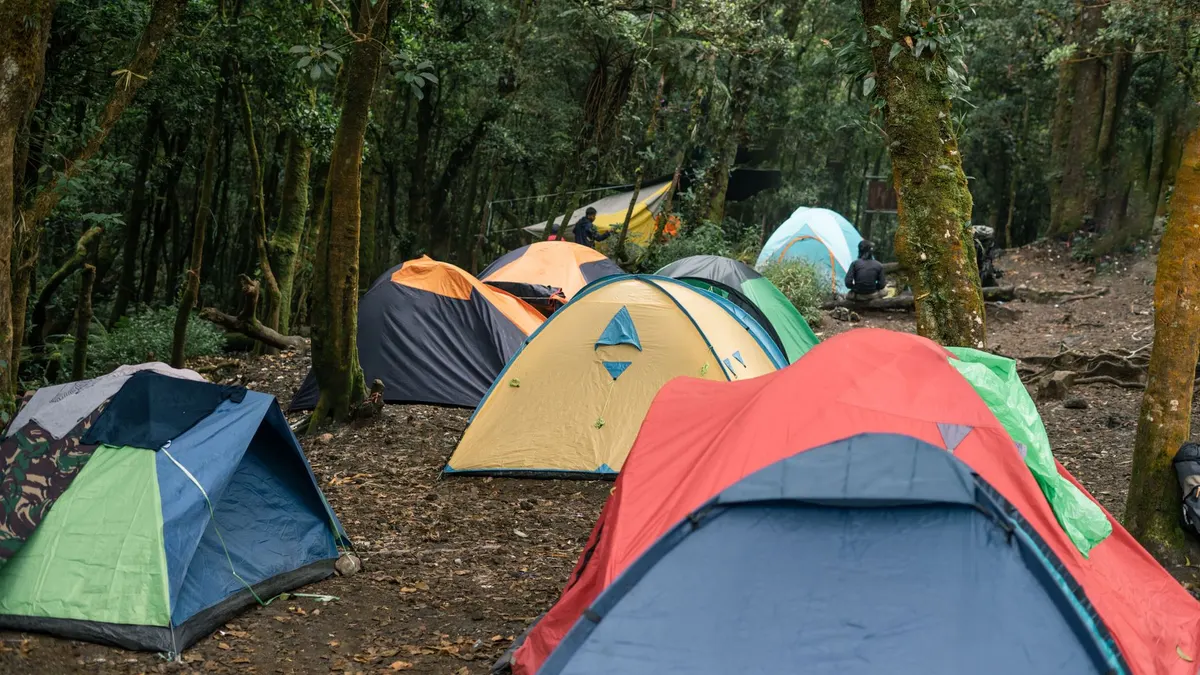
In a national park, you can camp only where that park has designated a place to camp. There is no general right to pull off and sleep, and there is no national list of where you can. The rule that decides it is written park by park, by the superintendent, in a document most visitors have never heard of.
The service-wide rule is short, and it hands the decision downward
Federal regulations for the National Park System live in 36 CFR. The camping section, 36 CFR 2.10, opens with one sentence that explains almost everything about why parks differ: “The superintendent may require permits, designate sites or areas, and establish conditions for camping.”
That is the whole mechanism. The regulation does not name campgrounds, set a stay limit, or say how many nights you get. It delegates.
Then 2.10(b) lists what is prohibited, and the last item on that list is the one that bites: “Camping outside of designated sites or areas.” Read that together with (a). Once a superintendent has designated where camping happens in a park, everywhere else in that park is closed to it. Not discouraged. Prohibited.
Parking overnight counts as camping
This is the part that catches people who are used to rest areas and public land. 36 CFR 1.4 defines the word: camping means “the erecting of a tent or shelter of natural or synthetic material, preparing a sleeping bag or other bedding material for use, parking of a motor vehicle, motor home or trailer, or mooring of a vessel for the apparent purpose of overnight occupancy.”
Parking a vehicle for apparent overnight occupancy is camping. So sleeping in the back of your car at a trailhead, in a scenic pullout, or in a visitor center lot is camping, and it is legal only where camping is legal. Some parks do allow overnight parking in specific lots, usually for backpackers with a valid permit. That permission is written into that park’s own rules. It is never something you can assume.
The Superintendent’s Compendium is the real rulebook
36 CFR 1.7(b) requires each superintendent to “compile in writing all the designations, closures, permit requirements and other restrictions imposed under discretionary authority,” update it annually, and make it available to the public on request. That compilation is called the Superintendent’s Compendium, and it is the document that actually answers your question.
Yellowstone’s compendium shows how specific it gets. Under its 2.10 section it states that a backcountry use permit, camping permit, or reservation is required to stay overnight in both frontcountry and backcountry areas, then names 12 frontcountry campgrounds (Bridge Bay, Canyon, Fishing Bridge RV Park, Grant Village, Indian Creek, Lewis Lake, Madison, Mammoth, Norris, Pebble Creek, Slough Creek, Tower Falls) as “the only areas designated for camping within the park,” alongside designated backcountry campsites. Undesignated camping in summer is prohibited unless a backcountry use permit prescribes it. In winter it is allowed with a permit.
The same document sets conditions you would never guess from the CFR: Class A and B campsites are limited to no more than 6 people sleeping per site, Fishing Bridge RV Park takes hard-sided vehicles only (“constructed of solid, non-pliable material”), and generators are prohibited between 8:00 p.m. and 8:00 a.m. except where designated by signs.
That is one park. Every other park has its own compendium with its own numbers. This is why “what are the national park camping rules” has no useful answer and “what does this park’s compendium say” always does.
The prohibitions that do apply everywhere
A handful of items in 36 CFR 2.10(b) are service-wide, so they travel with you from park to park:
- No digging or leveling the ground at a campsite.
- No leaving camping equipment, site alterations, or refuse behind when you go.
- No camping within 25 feet of a water hydrant or main road, or within 100 feet of a flowing stream, river or body of water, “except as designated.” That last clause is why a legal campground can sit on a lakeshore.
- No unreasonable noise between 10:00 p.m. and 6:00 a.m.
- No permanent camping facilities, and no connecting to a utility system except where designated.
- Violating conditions the superintendent established is itself a prohibited act, which is how compendium rules get enforced.
Violating any of these is a federal offense. 36 CFR 1.3(a) subjects a person convicted under these parts to the criminal penalties in 18 U.S.C. 1865. We have not read that statute’s current penalty figures, so we are not printing a fine amount here.
Food storage is a camping rule, not a suggestion
36 CFR 2.10(d) lets a superintendent designate areas where food, lawfully taken fish or wildlife, garbage, and cooking or storage equipment must be “kept sealed in a vehicle, or in a camping unit that is constructed of solid, non-pliable material, or suspended at least 10 feet above the ground and 4 feet horizontally from a post, tree trunk, or other object, or shall be stored as otherwise designated.”
Note the “as otherwise designated,” because parks use it. Yellowstone’s compendium adds bear-resistant food containers as an option and applies the requirement park-wide. Yosemite goes the other direction and removes an option the CFR offers: its own page states plainly that hanging food is illegal throughout Yosemite, and that food must go in an approved bear-resistant container or a food locker, placed 25 to 50 feet from your campsite. Two parks, two incompatible answers to “how do I store food.” Carrying the wrong assumption across a park boundary is how people get cited.
How to find your park’s actual rule
Start at the park’s own nps.gov site and look for the compendium, usually filed under management, laws and policies, or park regulations. It is normally a PDF. Search it for 2.10 and read that section, then read the 1.5 section for closures. If you cannot find it, 1.7(b) entitles you to request it.
Then check the campground page for the stay limit, the reservation requirement, and the season, because those change more often than the compendium does.
And on the ground, the sign wins. 36 CFR 1.7(a) makes posted signs one of the official ways a park tells you about a closure or restriction, which means the sign at the trailhead is not advisory, it is the notice. If a posted sign or a ranger tells you something different from what you read here or on a park web page you loaded last week, they are right and this page is out of date.
If the answer for your park turns out to be “no dispersed camping and the campgrounds are full,” that is normal, and the fix is usually just outside the boundary. See camping near a national park for the adjacent forest and BLM options, and how to find legal sites for the mapping tools that show you where the park land ends.
Sources
- 36 CFR 2.10, Camping and food storage (GPO)
- 36 CFR 1.3 Penalties and 1.4 definition of Camping (GPO)
- 36 CFR 1.5, Closures and public use limits (GPO)
- 36 CFR 1.7, Public notice and the compendium requirement (GPO)
- Yellowstone National Park, Superintendent's Compendium
- Yosemite National Park, Bears and Food Storage While Backpacking