


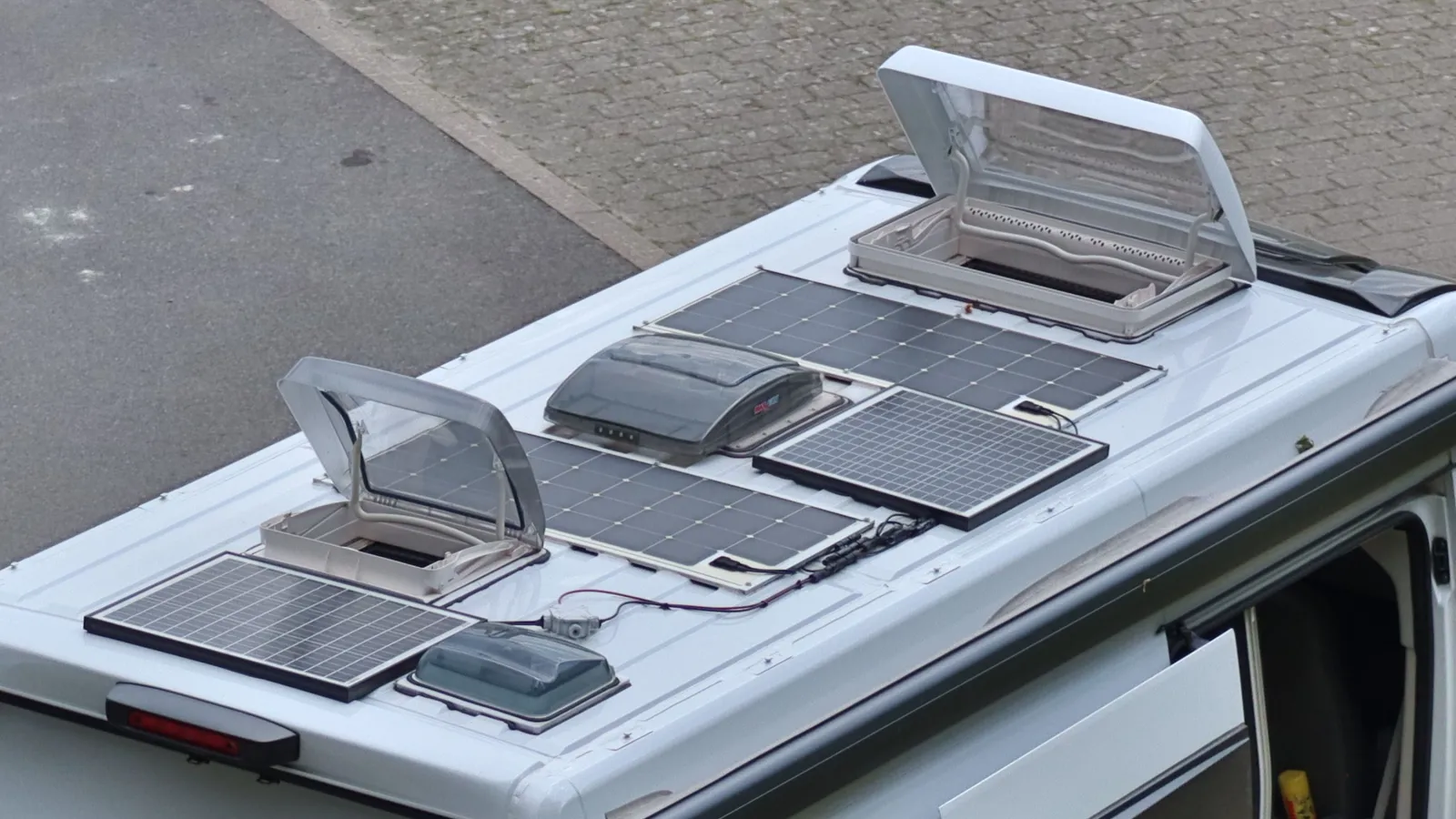
A 200W solar panel lying flat at Quartzsite, Arizona makes about 509 watt-hours a day in a typical December. In June the same panel makes 1,259. That is 40 percent of the summer harvest, in a town people drive to for winter sun. Tilt the panel steeply toward the south and the December figure rises to 952.
Those numbers come from PVWatts v8, the solar model run by the National Laboratory of the Rockies, a Department of Energy lab. We ran it on October 26, 2026 for a 200W south-facing array with the model’s 14 percent system loss figure. They are DC output, before your charge controller and battery take their own cut. In September our winter daylight piece could not get a December figure from PVWatts; the API now answers at its new address.
The working
Same 200W panel, same spot, typical-year weather, average watt-hours per day:
| Panel angle | June | October | December |
|---|---|---|---|
| Flat (0 degrees) | 1,259 | 806 | 509 |
| 34 degrees | 1,086 | 1,105 | 876 |
| 55 degrees | 836 | 1,120 | 952 |
Daylight alone does not explain the drop. The US Naval Observatory gives Quartzsite 14 hours 24 minutes of sun on June 21 and 9 hours 55 minutes on December 21, a 31 percent cut. Flat panel output falls 60 percent. The rest is sun angle: in December the sun stays low in the southern sky and hits a flat panel at a glancing angle all day.
That also changes the sun-hours figure you feed a sizing formula. PVWatts gives a flat surface at Quartzsite 3.06 kWh per square meter per day in December, which is 3.06 peak sun hours. At 55 degrees it is 5.67. If you sized your system on 4 to 5 sun hours, a flat array in December comes in short.
Going south is worth more than the clock says
Missoula, Montana gets 8 hours 32 minutes of daylight on December 21, 83 minutes less than Quartzsite. In the same model, a flat 200W panel at Missoula makes 160 Wh a day in December. That is less than a third of Quartzsite’s 509, from a daylight gap of under an hour and a half.
The catch
These are typical-year averages, not a forecast. A week of storm clouds is not in a monthly mean, and your worst three days are what empty the battery. We modeled an open rack; PVWatts has a separate roof-mount setting that we did not run. Shade is not in the model either.
The steep angle is a winter setting. At 55 degrees the panel makes 836 Wh in June, less than flat. A fixed 34 degree tilt gets you most of both: 876 Wh a day in December and 1,086 in June.
What to do
- Size from December, not June. For a desert winter, plan on about 2.5 Wh a day per watt of flat panel, or about 4.8 if you tilt to 55 degrees, and run your loads through the RV solar calculator.
- If your array is flat on the roof, consider a portable panel you can aim. In this model a 100W panel propped at 55 degrees makes about 476 Wh a day in December. The same panel lying flat makes about 254.
- Run PVWatts for your own coordinates. The how much solar guide walks through the formula, and free camping in Arizona covers where you can actually park.
Sources
- PVWatts V8 API documentation (National Laboratory of the Rockies, U.S. Department of Energy)
- PVWatts V8 run: Quartzsite, Arizona, 200W, flat
- PVWatts V8 run: Quartzsite, Arizona, 200W, 34 degree tilt
- PVWatts V8 run: Quartzsite, Arizona, 200W, 55 degree tilt
- PVWatts V8 run: Missoula, Montana, 200W, flat
- US Naval Observatory API, sun data for Quartzsite, Arizona, June 21, 2026
- US Naval Observatory API, sun data for Quartzsite, Arizona, December 21, 2026
- US Naval Observatory API, sun data for Missoula, Montana, December 21, 2026