


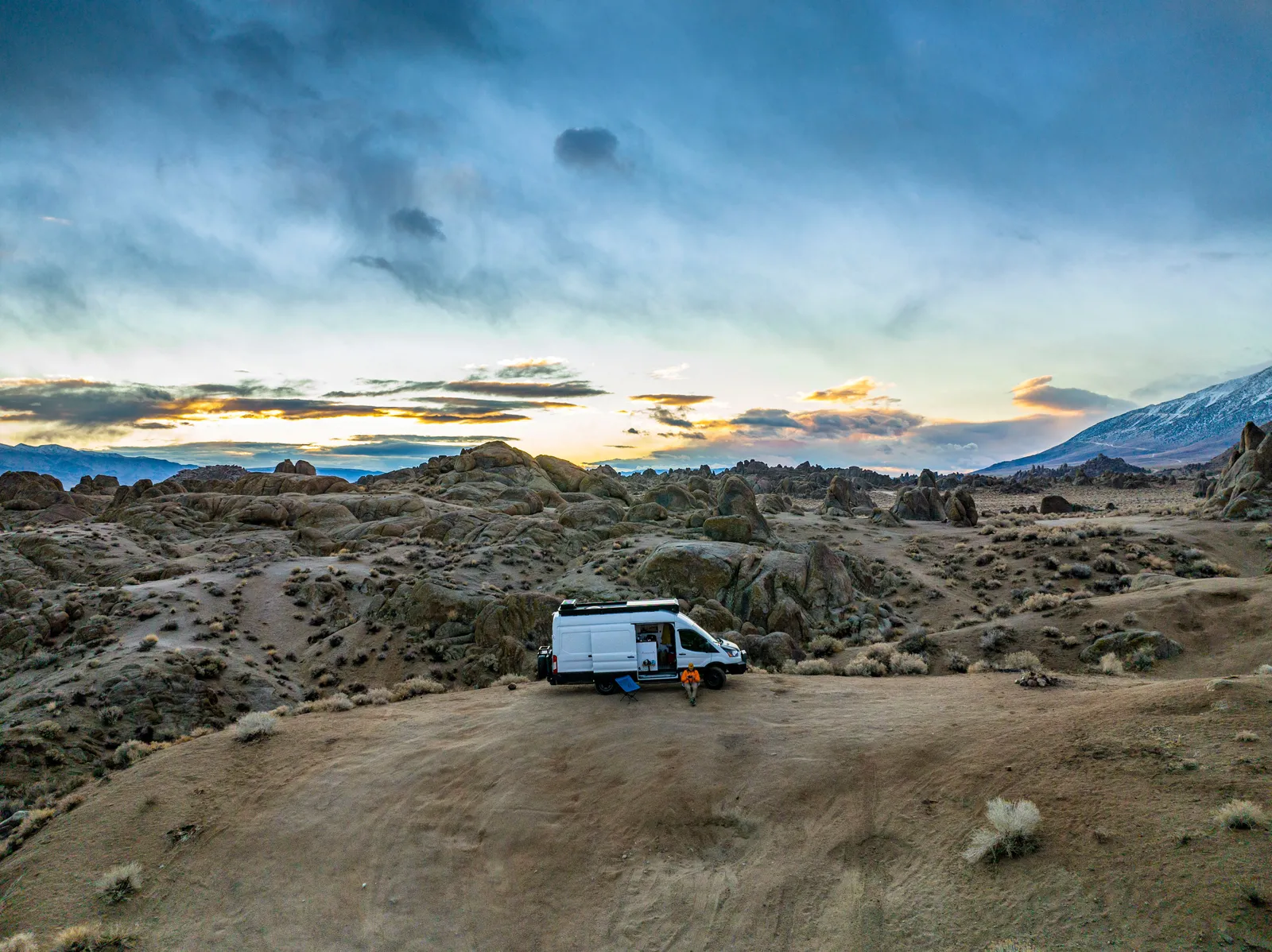
Driving to Arizona for the winter gains you a bit under an hour and a half of daylight a day compared with staying in Montana. It does not gain you a summer. On December 21, 2026 the sun is up for 9 hours 55 minutes at Quartzsite, Arizona and 8 hours 32 minutes at Missoula, Montana. Those are US Naval Observatory figures, pulled September 18, 2026.
Same source, same day, sunrise to sunset:
- Quartzsite, Arizona: 9 h 55 m, 7:38 a.m. to 5:33 p.m.
- Terlingua, Texas, at Big Bend: 10 h 16 m, 7:45 a.m. to 6:01 p.m.
- Missoula, Montana: 8 h 32 m, 8:18 a.m. to 4:50 p.m.
Now compare today. On September 18 those same three places are within eight minutes of each other: 12 h 17 m at Quartzsite, 12 h 15 m at Terlingua, 12 h 23 m at Missoula. Latitude is buying you essentially nothing right now. By the solstice it is buying Quartzsite 83 minutes a day over Missoula.
So size the bank off the night, not off the panel.
The number that actually constrains a boondocker in December is dark hours, because that is the stretch when the fridge, the furnace fan, the CPAP and the inverter’s own idle draw all run with nothing coming in. At Quartzsite the night on December 21 is 14 hours 5 minutes. At Missoula it is 15 hours 28 minutes. Tonight at Quartzsite it is 11 hours 43 minutes. Between now and the solstice, a Quartzsite winter camper’s overnight window grows by 2 hours 22 minutes, a little over 20 percent, without you changing a single thing you own.
Run that against your own overnight draw. At 4 amps through the night, that is roughly 9 extra amp-hours per night in December compared with tonight. At 10 amps, roughly 24. Our RV solar calculator and the battery sizing guide both take a daily watt-hour figure, and December is the month to feed them the honest one rather than the June one.
Now the part we cannot give you. Panel output does not scale with day length, it scales with irradiance, and the winter sun also sits lower in the sky, which costs you more than the clock does. We wanted to put a December watt-hour figure next to the daylight figure. NREL’s PVWatts API would not resolve from our network this run, so we have no sourced number, and we are not going to estimate one and dress it up as data. Treat daylight hours as the floor of the problem, not the whole of it. If you are sizing to the edge, size below it.
What to do with this before you leave: look up sunrise and sunset for your actual destination and your actual dates at aa.usno.navy.mil, subtract, and use the dark hours as the input to your battery math. Do it for the worst week of the trip, not the average one. If you are still choosing where to go, snowbird routes is the map side of the same decision, and free camping in Arizona covers what is actually open down there. Twenty minutes of December daylight is not a reason to pick one desert over another. Weather, elevation, and where you are allowed to park are.