

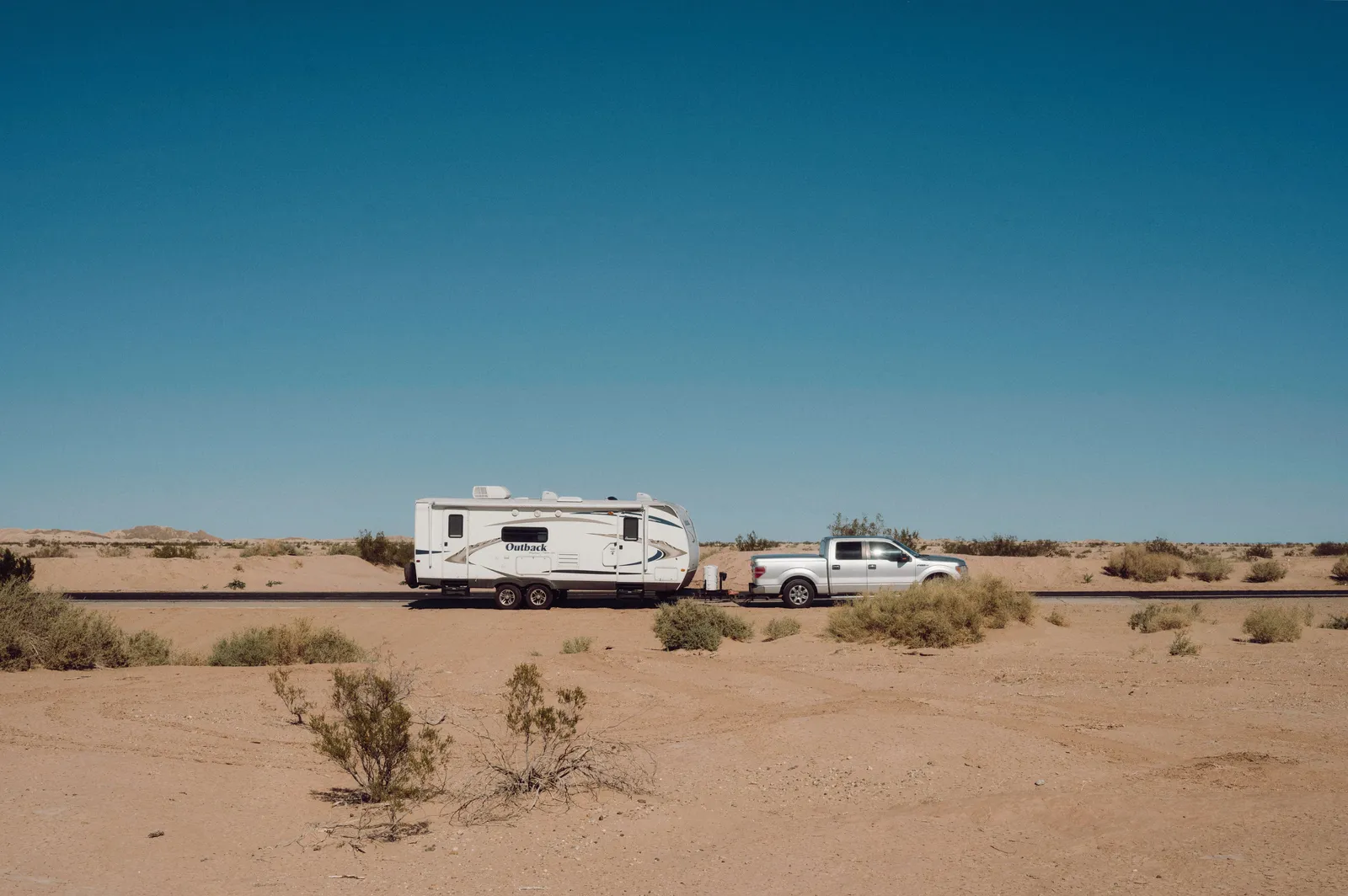
A basic California Class C license covers “any housecar 40 feet or less” and lets you tow a single vehicle rated at 10,000 pounds GVWR or less. Go past either line and the state wants something added to your license. None of it is a commercial license, and most people towing a big fifth wheel have never been told any of it.
The ladder, as the DMV writes it
The figures below come from the Recreational Vehicles and Trailers Handbook, DL 648, which is the handbook the DMV publishes today. Checked August 16, 2026. Note the revision stamp on it: REV. 11/2011.
With a basic Class C you may drive “a 2 axle vehicle with a GVWR of 26,000 pounds or less” and “any housecar 40 feet or less.” For towing, you may pull “a single vehicle with a GVWR of 10,000 pounds or less including a tow dolly, if used.” If your tow vehicle weighs 4,000 pounds or more unladen, that extends to a “trailer coach not exceeding 9,000 pounds gross,” a “trailer coach or 5th wheel travel trailer under 10,000 pounds GVWR when towing is not for compensation,” and a “5th wheel travel trailer exceeding 10,000 pounds but not exceeding 15,000 pounds GVWR when towing is not for compensation.”
That last line is where the endorsement comes in. The handbook: “A driver must have a fifth-wheel recreational trailer endorsement added to his/her Class C driver license to pull a fifth-wheel recreational trailer over 10,000 lbs., but not over 15,000 lbs. GVWR, which is not used for hire. This endorsement is not required if the driver has a commercial or noncommercial Class A driver license.”
Above 15,000 pounds GVWR on a fifth wheel, or above 10,000 pounds on a conventional travel trailer, you are into a noncommercial Class A. A motorhome over 40 feet but not over 45 sits under a noncommercial Class B, “with endorsement,” and the handbook exempts only noncommercial Class A and commercial Class A and B holders from that one.
Two rules apply across all three classes. You may tow only one vehicle with a noncommercial Class A, B or C. And under Vehicle Code 21715, “no motor vehicle under 4,000 pounds unladen may tow any vehicle weighing 6,000 pounds or more gross.”
The part that catches people
The threshold is GVWR, the rating on the trailer’s placard, not what the rig weighs on the day you hitch it. A 12,000-pound-rated fifth wheel loaded to 9,400 pounds is still a 12,000-pound trailer for licensing. Packing light does not move you under the line.
The endorsement itself is not much of an obstacle, which is the frustrating part: two written tests, a vision test, a form, and usually no fee. People skip it because nobody told them it existed, then find out after a collision, when the answer matters most.
What to do
Read the placard on your trailer and the length of your coach, then match them against the list above. If you are between 10,000 and 15,000 pounds on a fifth wheel, book the endorsement.
Two honest limits. The handbook DMV publishes carries a 2011 revision date, so confirm with the DMV before you plan around it. And this is California only: other states draw their own lines, and we could not open the Texas DPS license classes page this run, so we are not going to tell you what Texas requires. For where the rig can actually go once it is legal, read our California free camping page and the rig-size half of choosing a site.