


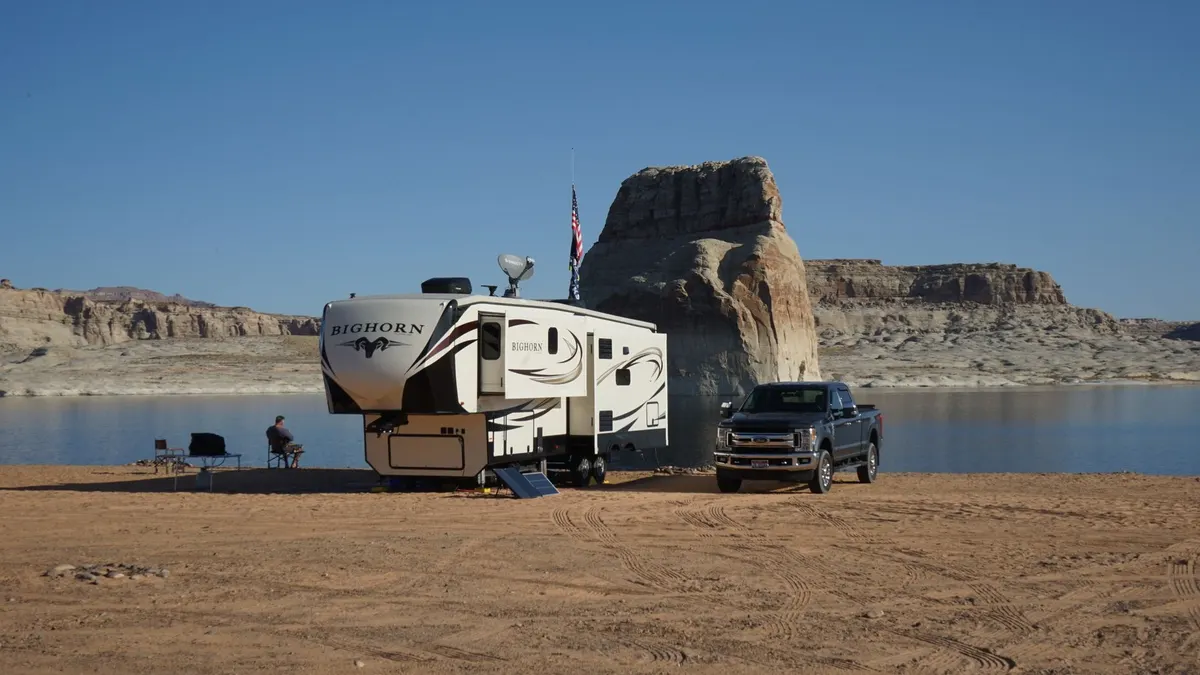
Quartzsite in January runs on two separate BLM systems, and knowing which one you are in is most of what you need. Two miles south of town, off Highway 95, is the La Posa Long Term Visitor Area: paid, permitted, serviced, and legal to occupy for the whole winter. Everywhere else on the surrounding BLM desert, the ordinary short-term rule applies, which is free and has a clock on it.
Pick the wrong mental model for the ground you are parked on and you get the rules wrong in both directions: paying for something that is free, or overstaying somewhere with a 14-day limit. The posted sign at the entrance and the BLM Yuma Field Office’s current guidance settle it, not this page.
The paid system: La Posa
La Posa was created in 1983, according to BLM’s page for it, to serve winter visitors and to keep the surrounding desert from absorbing that use in an uncontrolled way. It is approximately 11,400 acres and sits about 2 miles south of Quartzsite on Highway 95. BLM’s page refers to the four La Posa LTVAs, so it is a cluster of units rather than a single lot.
Fees and dates, checked on BLM’s own page on July 18, 2026:
- Long-term permit: $180, valid September 15 to April 15, a total of 7 months.
- Short-visit permit: $40, valid for any 14 consecutive days.
- Off-season, April 16 to September 14: $10 per vehicle day use, $15 per vehicle overnight, or $75 annually per vehicle, covering up to 5 people, with $1 for each person over that limit.
- Off-season stay limit: 14 days in a 28-day period.
The permit is not tied to La Posa. BLM’s LTVA brochure states both permit types are valid at any designated LTVA and that holders can move between them without paying again, so a $180 permit bought at Quartzsite also works at Imperial Dam or at the California LTVAs. Federal recreation passes do not discount it: the brochure says the America the Beautiful and Golden pass discounts do not apply to LTVA fees.
Services at La Posa, per BLM’s page: 10 ADA accessible vault toilets, 8 water faucets, a dry dump station, a dump station with water, trash service, plus a dance floor and a ramada. That is a lot by LTVA standards. The program brochure sets a much lower baseline for LTVAs generally, warning that in most cases running water, showers, and bathrooms are not available on site and that garbage and sewage must be hauled to the nearest disposal site. La Posa is the exception, not the rule, which is part of why the Quartzsite area draws the volume it does.
Two conditions come with the permit, from BLM’s LTVA supplementary rules. Your unit has to stay mobile, with wheels on all wheeled vehicles. And you cannot leave a campsite unoccupied for more than five days without prior approval from a BLM officer, so you cannot hold a spot with an empty trailer while you drive to Phoenix.
The full breakdown of how the permit works is on our LTVA page.
The free system: 14 days, then 25 miles
Outside the LTVA, the standard BLM short-term rule applies. The brochure states it plainly: campers who want to stay on the desert outside an LTVA may camp in one location on undeveloped public lands for up to 14 days in any 28-day period at no charge, unless otherwise posted. After 14 days, short-term campers must move to a new site outside a 25-mile radius of the original campsite.
That 25-mile radius is worth reading twice. It is a radius, not a drive. Moving to the next wash, or to the other side of the interstate, does not satisfy it.
The brochure also says something specific about this town: short-term camping in the Quartzsite area is limited, and there are five designated camping areas. So the free option near Quartzsite is not open desert wherever you like. It is a small number of designated areas, and outside them you should assume camping is restricted until a sign or the field office tells you otherwise.
We could not retrieve a current official BLM page naming those five areas today, so we are not going to name them from memory or from a camping app. Call or visit the Yuma Field Office and ask which areas are designated for short-term camping this season, because the designations and their boundaries are the kind of thing that gets revised. Our stay limits guide covers how the 14-in-28 window counts if you are moving between areas.
January, honestly
January is the peak. The RV show and the gem and mineral shows land in the same stretch of weeks, and the winter population of the area is many times its year-round size. That much is not in dispute.
What we will not do is give you a number. We tried to verify an attendance or peak-population figure from the Town of Quartzsite’s own site and from BLM, and could not retrieve one today. Every large round number you have seen quoted for Quartzsite in January traces back to press coverage or a blog rather than to a published count, so we are leaving it blank rather than repeating it. If you need a figure for planning, ask the town or the Yuma Field Office directly.
What the crowd means practically is easier to state without a number:
- The designated short-term areas fill. Arriving in the first week of January and expecting to pick a spot is optimistic. The LTVA is large, and volume is the reason its long-term permit exists.
- Services queue. Dump stations and water faucets that are adequate in November have lines in January. Build the wait into your water plan rather than arriving on an empty tank. See our dump station guide for how to think about the haul.
- Groceries, fuel, and propane are all busier. The town’s retail capacity is sized somewhere between its summer population and its winter one, which means neither season feels quite right.
- Enforcement is more visible than it is on quiet BLM ground. With that many rigs concentrated in a small area, permits get checked and stay limits get tracked. The 14-day clock is a real clock here, not a theoretical one.
Where to sleep, and who decides
The short version: if you want to stay put for the winter and you can pay, buy the long-term LTVA permit and stop thinking about the clock. If you are passing through for two weeks or less, compare the $40 short-visit permit against a free designated short-term area, and note that the LTVA buys you water, trash, and a dump station that the free areas may not have.
Either way, the decision about where you are actually allowed to park is made by the sign at the entrance and by the BLM Yuma Field Office, not by this page and not by an app. Designations change, fee schedules change, and areas close. Read the sign, ask the host at the entrance station, and if the answer you get on the ground differs from what you read here, the person on the ground is right.
For what BLM land allows more generally, see BLM camping rules. For what else is verified in the state, see our Arizona free camping page and the rest of the state pages. For fitting Quartzsite into a longer winter, see snowbird routes.