


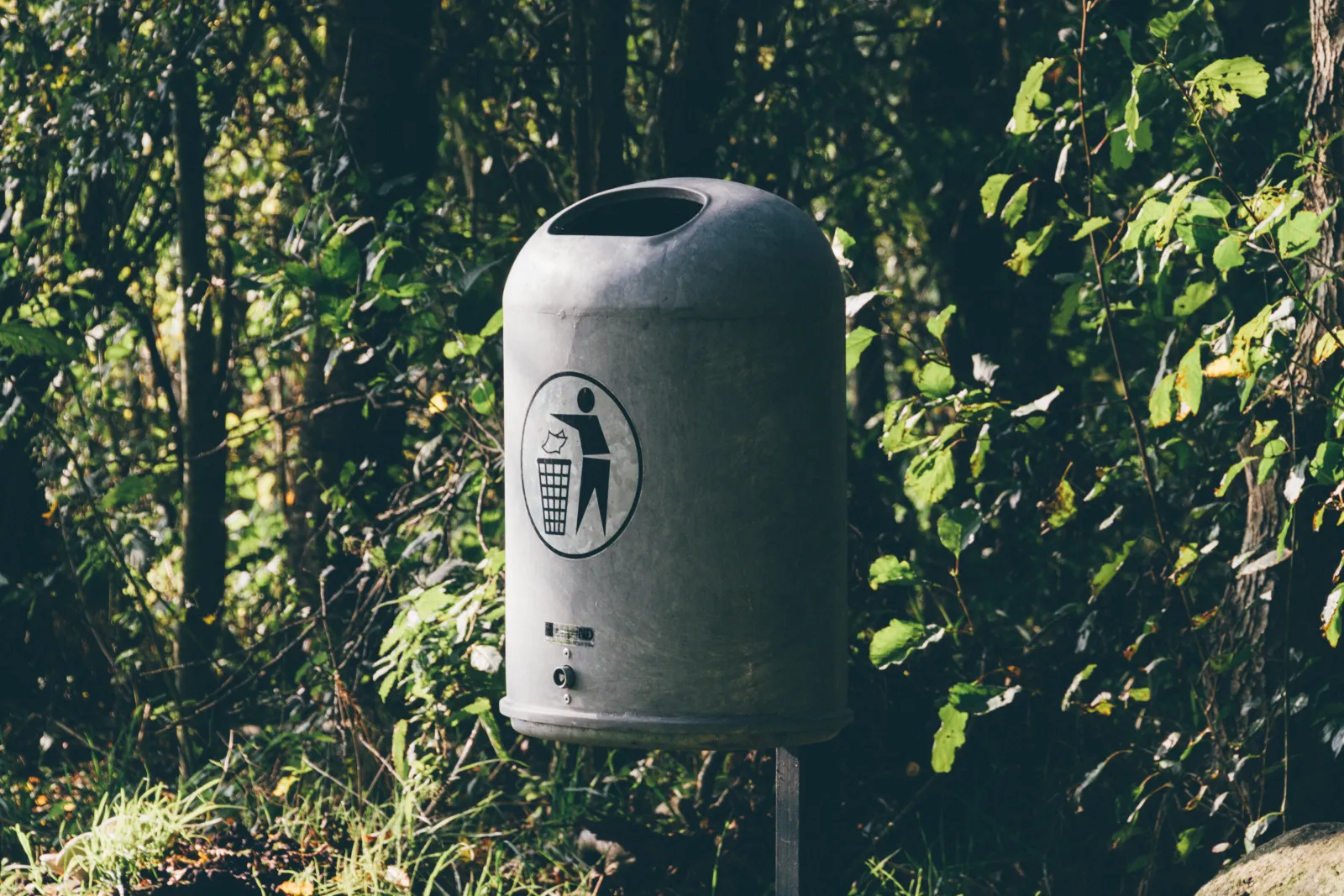
No. On BLM land, in national forests and in national parks, federal regulations bar dumping household trash you brought from home, or from any other private property, into a government trash can or dumpster. Trash you make while you are camping there can go in a receptacle provided for it. If there is no receptacle, you carry it out. We read all three rules on eCFR on October 24, 2026.
What the three rules say
BLM, 43 CFR 8365.1-1. It opens with: “Whenever practicable, visitors shall pack their trash for disposal at home.” Then it prohibits disposing of “any household, commercial or industrial refuse or waste brought as such from private or municipal property,” and using “a refuse container or disposal facility for any purpose other than for which it is supplied.” Cans, bottles and other nonflammable trash go only in designated places or receptacles. Under 43 CFR 8360.0-7, breaking these rules is punishable by a fine of up to $1,000 and/or up to 12 months in jail.
Forest Service, 36 CFR 261.11. You must dispose of all garbage “either by removal from the site or area, or by depositing it into receptacles or at places provided for such purposes.” Dumping trash “brought as such from private property” is prohibited unless a container “has been provided and is identified as such, to receive trash generated from private lands.” So a forest can set up a container for outside trash, but it has to be marked that way. The same section also prohibits leaving refuse “in an exposed or unsanitary condition.”
National Park Service, 36 CFR 2.14. It prohibits using government receptacles “for dumping household, commercial, or industrial refuse, brought as such from private or municipal property, except in accordance with conditions established by the superintendent.” The default is no, and only a park’s own conditions change that.
Three agencies, the same line: the can at the trailhead is for the trash the trailhead made.
The part the rules do not settle
All three hinge on “brought as such,” and none of them defines it. A bag you filled at home or during a week at a private RV park reads like trash brought from private property, and we would treat it that way. What we cannot tell you is how a ranger treats a full-timer’s bag that holds three days of camp trash and one day from a town stop. The regulation does not say, so we will not guess. If you are unsure, ask the field office or ranger station, or use a town transfer station.
One BLM detail people miss: flammable trash may be burned, but only “in authorized fires.” A fire restriction order can take the fire away entirely. See our fire restrictions explainer.
What to do
- At a dispersed site, plan to pack out everything. There is usually no receptacle, so carrying it out is the default under all three rules. The one exception is the BLM burning clause above. Budget trash space like you budget water.
- At a campground or LTVA with trash service, use it for camp trash only. Some sites provide it as an amenity; La Posa LTVA lists trash service among its facilities.
- Read the sign on the container. A posted local rule, or a Forest Service container marked for private-land trash, beats this page.
Liquid waste has its own rules. For gray and black water, see can you dump gray water on the ground. For the basics of camping outside campgrounds, start with our dispersed camping guide.
Sources
- 43 CFR 8365.1-1, Sanitation (BLM), eCFR, up to date as of October 22, 2026
- 36 CFR 261.11, Sanitation (Forest Service), eCFR, up to date as of October 22, 2026
- 36 CFR 2.14, Sanitation and refuse (National Park Service), eCFR, up to date as of October 22, 2026
- 43 CFR 8360.0-7, Penalties (BLM), Cornell Legal Information Institute