


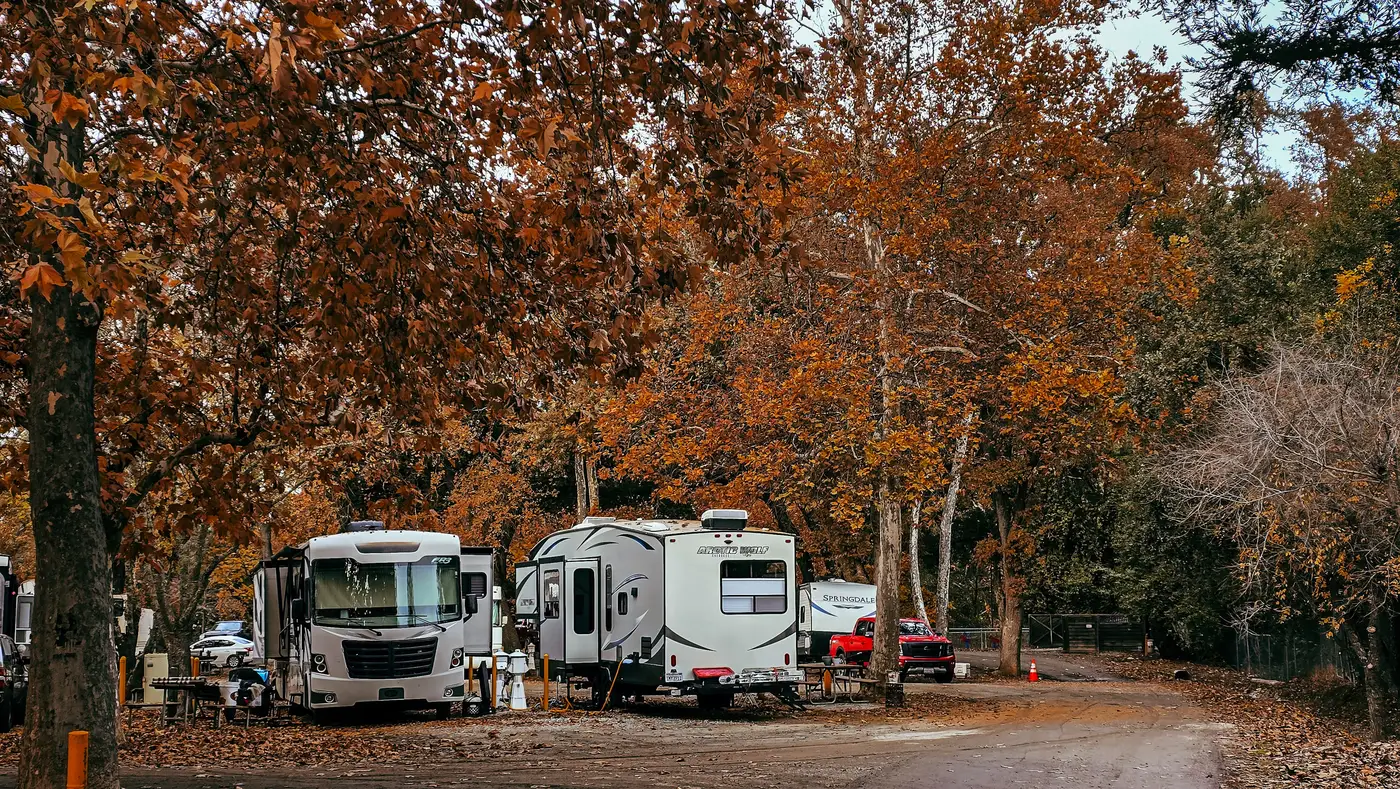
If you are pulling in with a trailer and a second rig, or a trailer and a van, assume one of them does not get power. Several federal campgrounds now limit each site’s electric pedestal to a single camper unit, and they say why: the circuits and the transformers behind them were not sized for two.
Smith Ridge and Holmes Bend, both Corps of Engineers campgrounds in Kentucky, publish the identical regulation: “To prevent overloading electrical circuits, only one (1) camper unit may be plugged into the campsite electric pedestal. Unoccupied or unrented campsites may not be utilized for electric service.” We read both listings September 22, 2026.
Little Fir, on the Arkansas side, is putting the same rule in place with a date on it: “Effective March 1, 2027, each campsite will be limited to one sleeping unit requiring 30-amp or 50-amp electrical service.” The stated reason is “to prevent overloading the electrical transformers serving this area.”
The plug-in sequence, from the one campground that writes it out
Indian Boundary, in the Cherokee National Forest, is the only listing we found that publishes a procedure rather than a prohibition. Make sure the breakers are off before you plug the cord in. Turn them on after. Close the cover “so that water does not get into the outlets.” Turn the breaker off before you pull the cord out at the end of your stay. The campground says plainly what it is protecting: “it helps prevent the electric breakers from failing during your stay.”
It also asks campers to run one appliance at a time and not to run the air conditioner alongside anything else, television included. That is a small campground being honest about its supply, and it is more useful than a sticker saying 30 amps.
What almost nobody tells you
We read the notice text on all 5,435 campground listings on Recreation.gov on September 22, 2026. Exactly one addresses who carries the cost when pedestal power goes wrong: Furnace Creek, in Death Valley, which states that “Campers are responsible for protecting their RVs and appliances from power surges.” We covered the rest of what Furnace Creek says about its pedestals separately.
Every other listing is silent on it. Silence is not a warranty. It means nobody has written the answer down, and the default in that situation is that your converter, your inverter and your fridge are your problem.
What to do
Carry a surge protector that reads the pedestal before it passes power through, and plug it in first. Then read the notice block on your campground’s Recreation.gov listing before you arrive, because that block is where these rules live rather than on the agency’s own site.
If you travel with two units, book two sites or plan for one of them to run on battery. Do not run a cord to the empty site next door, which the Corps rules out by name. And check the amperage on the post rather than assuming: Union Creek in Oregon notes that its RV site breakers are not rated for charging an electric vehicle, which is a useful hint about how much headroom is really there.
Our power budget guide covers what your rig actually draws, and the RV solar calculator covers the nights you spend without a pedestal at all. The posted rules at the campground and the host on site beat any website, this one included.
Sources
- Recreation.gov, Smith Ridge Campground (US Army Corps of Engineers, Kentucky) listing, read September 22, 2026
- Recreation.gov, Little Fir Campground (US Army Corps of Engineers, Arkansas) listing, read September 22, 2026
- Recreation.gov, Indian Boundary Campground (USDA Forest Service, Tennessee) listing, read September 22, 2026
- Recreation.gov, Furnace Creek Campground (National Park Service, California) listing, read September 22, 2026
- Recreation.gov, Union Creek Campground, Rogue River (USDA Forest Service, Oregon) listing, read September 22, 2026